Meat cutting room — mesh glove and cut-resistant apron on every operator, before the first cut.
In a meat cutting room, a badly worn mesh glove is a cut finger. iLEAN Vision verifies that every operator wears the full cut-resistant glove and apron before the first cut and throughout the shift. The prevention manager signs off — the knife does not touch the carcass until the PPE adds up.
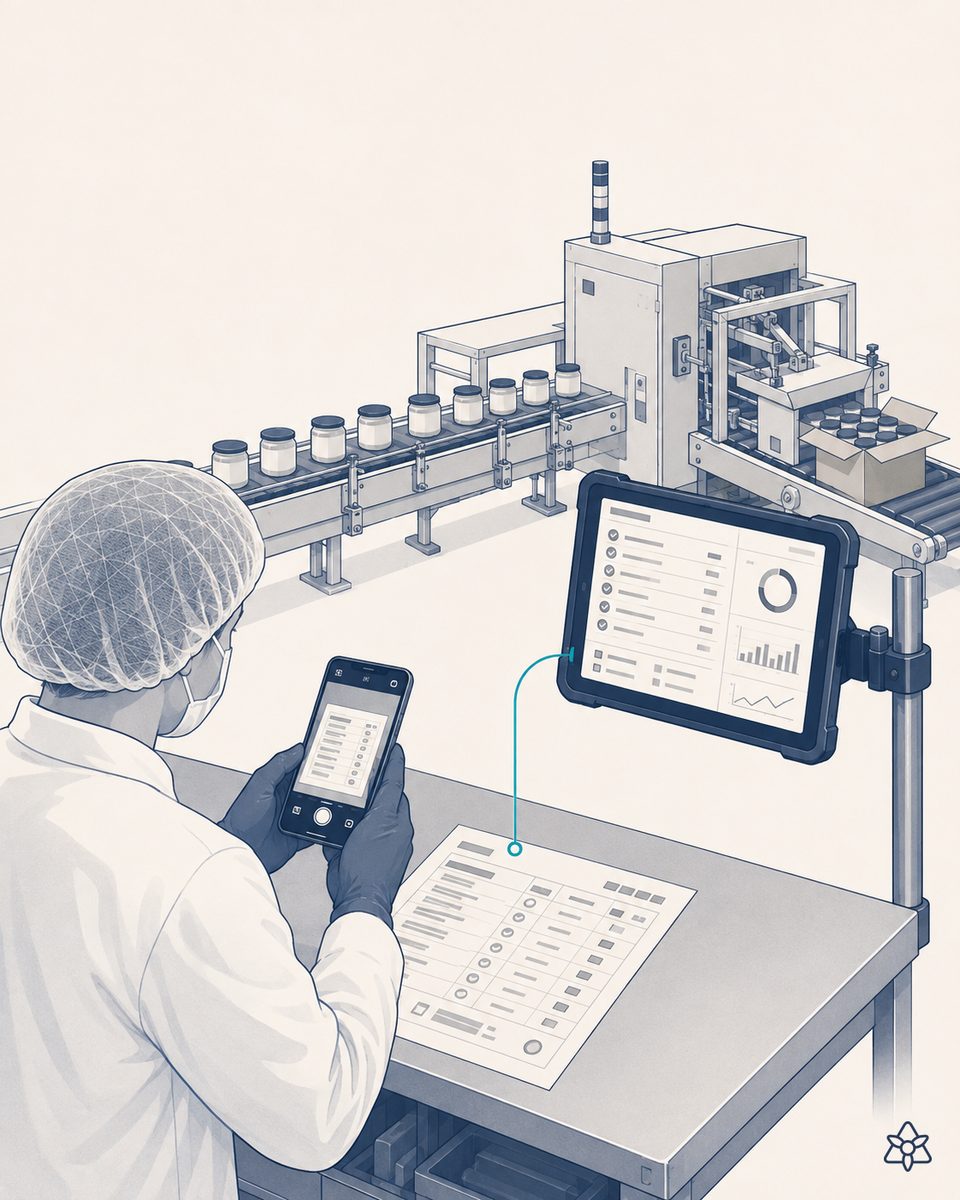
The veteran who "can't grip the fine cut with the glove on" — and the room that loses a finger a year.
In a meat cutting room, the cut-resistant PPE is well defined in the station's procedure. The operator knows it. The prevention manager knows it. Even so, three realities make the 1% materialise:
- The veteran who says the mesh glove keeps them from gripping the fine fillet — and takes it off at the start of the precision cut.
- The mid-shift station change — the operator rotates to an operation where the required PPE is different, and the physical change never happens.
- The wet or shifted apron — which the operator takes off to "be more comfortable" at exactly the station where they need it most.
The shift supervisor knows this, but cannot be at forty stations at once. The room is loud, the operator is focused, the chain's pace never stops. The classic system works 99% of the time. That 1% is the deep cut — and each one means six to twelve months of leave, an overloaded team, a case file and, at times, a court ruling the committee pays for years later.
iLEAN does not replace the supervisor — it gives them forty extra pairs of eyes, at every station, all shift long.
The problem with cut-resistant PPE in the cutting room is not a lack of procedure: it is verification that lives in one person who physically cannot be at every station at once. iLEAN acts as the filler that closes that gap, without asking you to change the room, the prevention ERP or the procedure. See the category: full IRIS architecture.
Edge sees the glove and the apron at every station, all shift. Connect reads the station's authorised operation. The agent cross-checks and, if PPE is missing, alerts the supervisor in the earpiece. The person signs off — never the other way round.
The three iLEAN pieces applied to cut-resistant PPE in meat cutting:
- iLEAN Vision (Edge) — one or several terminals with IP69K cameras aimed at the cutting stations. The CNN is trained on the approved PPE catalogue and recognises the mesh glove, the cut-resistant apron, the sleeve and the gaiter. It looks at the garment on the person, with no facial recognition. It works with no network: if the line goes down, Edge keeps verifying against the last synchronised set.
- Connect — captures the authorised operation at each station from the MES or the shift roster (which often lives in the room manager's spreadsheet), the PPE catalogue per operation and any station change communicated by WhatsApp or by the aisle supervisor.
- Agent — cross-checks station, operation, required PPE and detected PPE. If a piece is missing, it does not send an email after the fact: it alerts the shift supervisor by earpiece or app, with a photo and the specific station. The decision stays with the person — the system assists, it does not decide in their place.
Manual cut-resistant PPE control vs. verification with iLEAN Vision
| Aspect | Shift supervisor + eye | With iLEAN Vision + Connect + Agent |
|---|---|---|
| Mesh-glove check at the start of the shift | Supervisor's glance at the entrance | Individual verification before the first cut |
| Detecting an apron removed mid-shift | If the supervisor happens to walk by | Continuous detection, alert to the supervisor |
| Station change to another operation | The operator's assumption | Cross-check with the MES roster; alert if the PPE does not match |
| Wet environment and reflections | n/a | IP69K cameras with a polarised filter |
| Traceability for the labour inspectorate | Reconstructed from reports | Dossier per shift and per station, automatic |
| Operator privacy | n/a | No facial recognition; identification by station |
Impact estimate for your plant — to be validated with your numbers.
The block below is an estimate to be validated with the specific figures of your plant. We set it out so the committee has an order of magnitude; we refine it during the diagnostic.
- Cutting room or slaughterhouse with 30-60 operators per shift, several specialised stations (deboning, filleting, primary cutting).
- Edge pilot at 2-3 critical stations (IP69K cameras + integration with the MES/shift roster). First expected value within a few weeks: a verification rate genuinely useful for the prevention service.
- Indicative payback between 4 and 9 months, depending on the number of stations covered, the documented frequency of cut accidents in recent years and the average cost per leave.
- Expected reduction in cut-resistant PPE non-compliance of ≥ 30% versus the previous manual control, with a floor that is reasonably defensible before the committee.
- The hard lever is a single long deep-cut leave avoided: direct cost + station cover + investigation + insurance premium.
And the prevention manager's reasonable doubt
"What if the AI confuses an ordinary glove with a mesh one?" — hallucination is a problem of free generation, not of anchored tasks. In tasks where the AI simply classifies an image against a defined catalogue (this glove is / is not the approved mesh model), the best models brought the error below 1.5% [1]. And even so, what is critical is never decided alone: the system alerts the shift supervisor and the person signs off. The three safety rings are there for exactly this.
[1] OpenAI paper "Why Language Models Hallucinate", 2025 — on the reliability of AI in anchored tasks.
What people ask about cut-resistant PPE detection in meat cutting
What PPE do regulations require in a meat cutting room?
The station's risk assessment (in Spain, Law 31/1995 on occupational risk prevention and derived regulations) obliges the employer to provide sufficient PPE against cut and puncture risk: an EN 1082 metal mesh glove on the hand holding the piece, an EN 14328 cut-resistant apron over the chest, a forearm sleeve and, depending on the station, protective gaiters. The exact combination varies by operation (deboning, filleting, primary cutting, channelling). The classic system (shift supervisor + observation) covers most stations — the remaining 1% is the deep cut that lands on the serious-accident list.
How does iLEAN Vision tell a mesh glove from an ordinary glove?
The neural network (CNN) is trained on the specific PPE catalogue the plant uses — approved mesh-glove models, fastening positions, visible colour and pattern. Metal mesh has a very recognisable pattern for the CNN; what sets iLEAN apart is that it is trained on your models, not on a generic one. If a glove that is not in the approved catalogue comes in, the system flags it as not validated and leaves the decision to the prevention manager.
What happens if an operator removes the apron mid-shift?
iLEAN Vision is not only entry verification — it keeps checking the room during the shift. If the camera detects that a station is operating with the cut-resistant apron removed or the mesh glove off, the agent alerts the shift supervisor through Connect (earpiece or app), not by an end-of-day email. The decision stays with the person: stop the station, give a verbal reminder, or reassign the task. The system assists; it does not replace the supervisor's judgement.
Can the cameras see through the water and grease of the cutting room?
Yes, with the right equipment. The cameras are chosen with an IP69K protection rating (resistance to the high-pressure, high-temperature water jets of meat-room washdowns) and stainless-steel or sanitary polycarbonate housings. The optics are chosen with a polarised filter to mitigate water reflections on the stainless steel. The deployment takes the washdown positions and the points of least splashing into account. It is an industrial solution, not an adapted webcam.
How much is recovered by avoiding a single deep-cut leave?
The calculation is not just the direct cost of salary during the leave — it is the indirect cost: covering the station, overloading the team, stopping the station on the day of the accident, the internal investigation, a possible case file and a rise in the accident-insurance premium. For a specialised deboning station, a single long leave from a deep cut can pay for the pilot. Send us your plant's real data and we will send back the estimated ROI within 48h, not a generic case.
More cases in ilean vision
- ANPR license plates at the B2B loading dock with AI — the truck docks and the order appears without anyone typing.How iLEAN Vision reads the truck plate at the B2B loading dock and links the ERP loading order with no…
- ATEX PPE in a refinery zone — the spark that must never come off the clothing.iLEAN Vision verifies helmet, footwear and antistatic/anti-spark clothing on every operator before…
- Grade C/B pharma cleanroom — cap, mask and overgloves verified before access.iLEAN Vision confirms cap, mask and overgloves before access to a grade C/B pharma cleanroom, holds the…
- Data Matrix reading in SMT with AI — a misread component is not a defect, it is half a board in the scrap bin.iLEAN Vision reads Data Matrix codes on SMT components at pick-and-place speed — without slowing the…
- Starting the press with the wrong die — and finding out with the first broken stroke.iLEAN Vision recognises the die installed in an automotive stamping press and blocks start-up with the…
- Float glass for automotive with AI — the inclusion shows on the table, not in the furnace.iLEAN Vision detects inclusions, bubbles and scratches in float glass before tempering for automotive…
Tell us your case and within 48h we will send you the estimated ROI of this AI project for your cutting room.
We work on your plant's real data, not on ours. Diagnostic with no commitment.
Request estimated ROI in 48h See iLEAN Vision