Coordinated rings against heat deviation and downgraded product
The capital pain of a long steel plant is the same everywhere: zero chemical or mechanical deviation per heat discovered downstream. A single bad heat discovered at the customer destroys the relationship with a Tier 1 and puts the IATF approval at risk. The iLEAN flagship system coordinates the previous eleven pieces into 4 verification rings that cross-check each other — ERP and heat order · laboratory · Edge on the line · coil marker —: if the 4 do not agree, JIDOKA AI blocks the line before the coil leaves. It is the flagship built so the industrial director and the quality manager can defend the same decision before the committee and before the customer without translation.
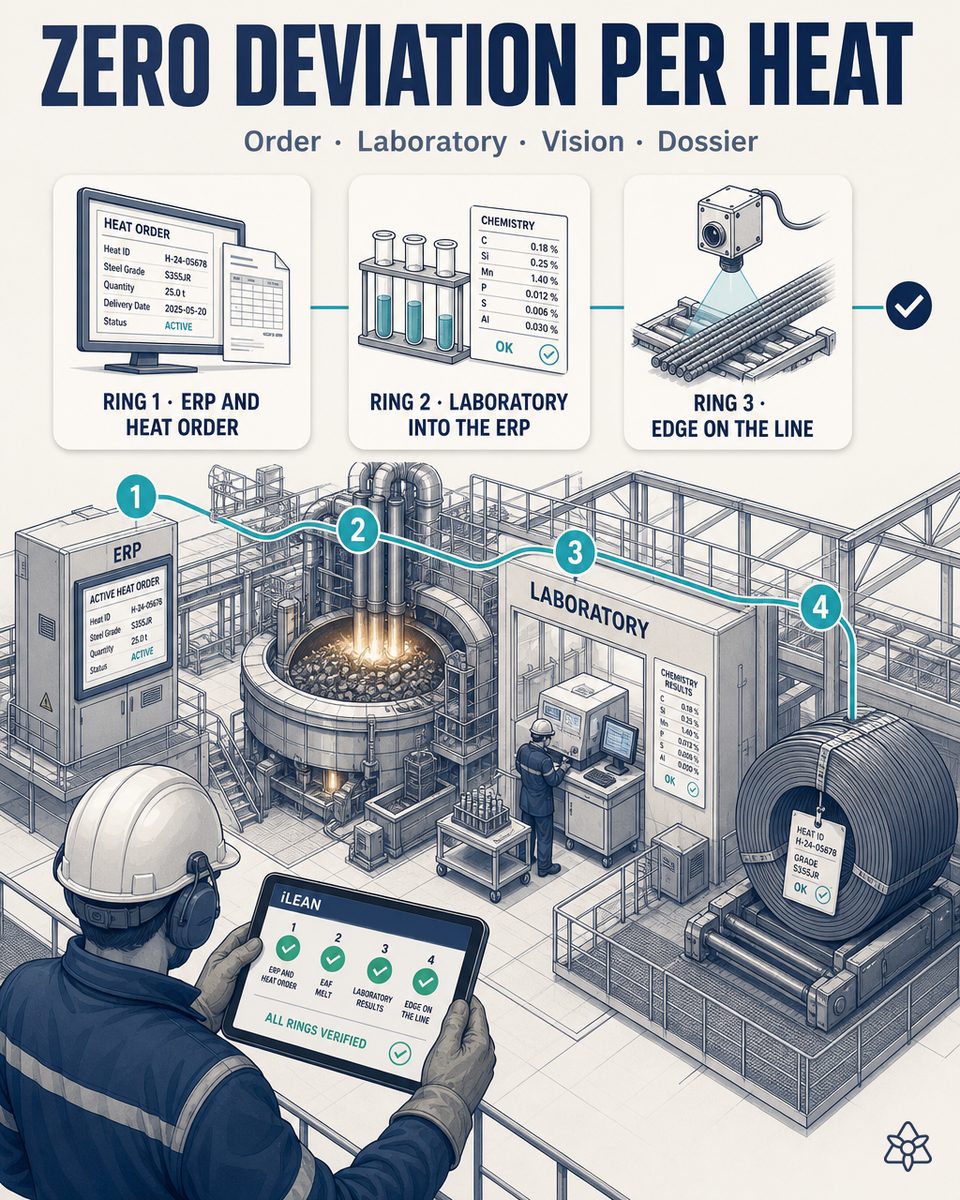
A bad heat discovered at the customer is not a quality incident: it is the Tier 1 relationship at stake.
In a long steel plant, the chemical or mechanical deviation per heat discovered at the customer is the sub-sector's biggest reputational and economic risk. A carbon content outside the destination standard's window, a yield strength that fails the customer's test, a coil labeled with another order's grade — each incident costs between tens and hundreds of thousands of euros in direct terms: claim, sorting, material return and urgent transport. But the direct cost is the least of it: behind it comes the damage to the Tier 1 customer relationship — built over years and approved heat by heat — and the risk of suspension of the IATF approval with a critical customer for months.
The error is almost never in the furnace. It lives in the coherence between four points that should say the same thing and sometimes do not: what the heat order defines in the ERP (target recipe, scrap mix, customer and destination standard), what the laboratory actually measured in composition and mechanical tests, what the drawing and rolling line is really producing in gauge and surface, and what the coil marker prints on each coil's label. A mismatch at any of those four points is invisible to the rest until the customer's receiving detects it — or their stamping line, which is worse.
And the nature of the process multiplies the risk: every heat is unique and unrepeatable, laboratory results often travel in spreadsheets someone transcribes, and between tapping and the shipped coil enough shifts and hands go by that memory is not an acceptable protection mechanism. Either the four points verify each other on the shop floor, or the first finding is made by the customer.
The 4 coordinated rings — the heart of the system.
No ring closes the risk on its own. What shields the shipment is that the four cross-check each other: each one verifies what the previous one said, and none lets a coil leave without the other three agreeing.
- Ring 1 · ERP and heat order. As the single source of truth, the active heat order defines the target recipe, the scrap mix, the customer and the destination standard — with external customer and supplier alerts already integrated by Connect, so the heijunka recalculates in real time. Everything that happens afterwards is measured against this definition, not against anyone's memory.
- Ring 2 · Laboratory into the ERP. The chemical composition and mechanical tests of each heat feed directly into the ERP's QM, with the metallurgist validating data already cross-checked against the destination standard's window. Heat release drops from hours to minutes, and manual transcription — the classic source of the badly discovered deviation — disappears from the map.
- Ring 3 · Edge on the line. The camera over drawing and rolling detects the surface defect and validates the caliber change against the active heat order. If what the line is producing does not match what the order says — a gauge from another reference, a surface off pattern —, JIDOKA AI blocks the line at that moment: the discrepancy stops on the shop floor, not at the customer.
- Ring 4 · Coil marker and evidence pack. Every coil leaves with a label cross-checked against the three previous rings — the order that defined it, the laboratory that released it and the Edge that verified it — plus a PPAP-ready dossier per batch with the quality technician's signature. If the customer or the auditor asks, the answer already exists reconciled; nobody has to rebuild it by hand.
A fifth element is not a ring — it is what lets the four not penalize productivity: SMED AI accelerates format and caliber changes — with the propagation of order, standard and labeling included — so that coordinating four verification points does not mean penalizing OEE. The coordination protects without slowing down.
See the full IRIS architecture →
Satellite cases from the same plant, with each ring's technical detail: from the laboratory's Excel to the ERP (Ring 2) · surface defect in wire drawing with Edge (Ring 3) · coil marker integration (Ring 4) · evidence pack for IATF (Ring 4).
Plant without coordinated rings vs. plant with the 4 iLEAN rings
| Aspect | Plant without coordination | Plant with the 4 iLEAN rings |
|---|---|---|
| Heat order (recipe, scrap mix, customer, destination standard) | Read on paper or a screen, transcribed by hand at every station; customer alerts arrive by email and someone reschedules | Ring 1 (ERP): the active order defines everything as the single source; external alerts enter via Connect and the heijunka recalculates in real time |
| Laboratory results (composition and mechanical tests) | Travel in spreadsheets and get transcribed; heat release in hours, with typing errors possible | Ring 2: feed into the ERP's QM cross-checked against the destination standard, with the metallurgist's validation; release in minutes |
| Surface defect and caliber change on the line | Manual visual sampling; the discrepancy is discovered in the customer's test or on their line | Ring 3 (Edge): surface and gauge cross-checked on the line against the active order; JIDOKA AI blocks the line if anything does not match |
| Labeling and evidence per coil | The marker is programmed by hand; evidence is rebuilt if the customer claims | Ring 4: label cross-checked against the three previous rings and a PPAP-ready dossier per batch, signed by the quality technician |
| Format and caliber change | Penalizes OEE; changeover pressure multiplies startup errors and degraded heats | SMED AI accelerates the change with order, standard and labeling propagation included; fewer dirty starts |
| Deviation incidents discovered downstream | 3-8 per year, some with a risk of a major claim | Zero — the discrepancy is detected on the line (on the shop floor), not at the customer; regional OEE grows by avoiding dirty starts and degraded heats |
Impact estimate for your plant — to be validated with your own numbers.
The block below is an estimate to be validated against your plant's actual data. We put it forward so the committee has an order of magnitude; we refine it during the assessment.
- Long steel plant with several product families and simultaneous destination standards, Tier 1 customers with IATF approval, its own laboratory and frequent format and caliber changes in drawing and rolling.
- Pilot on the highest-risk line with the 4 rings coordinated — ERP and heat order, laboratory into the QM, Edge with JIDOKA AI and coil marker with evidence pack. First value within a few weeks starting with the laboratory ring.
- The hard lever for Quality is the protection of the IATF approval and of the multi-year relationship with the Tier 1 customer — an asset whose value far exceeds the one-off cost of any single incident.
- The hard lever for Operations is avoiding the incident of tens to hundreds of thousands of euros in direct costs that a single badly discovered heat triggers — claim, sorting, return and urgent transport — plus the OEE recovered by avoiding dirty starts and degraded heats.
- Indicative payback between 6 and 12 months, counted against the first avoided incident. With a single serious event avoided, the system pays for itself.
And the fair question: "what if the system itself gets it wrong?"
The right question from the quality manager. Two answers that hold each other up. The technical one: hallucination is a problem of free generation, not of anchored tasks — cross-checking the laboratory's composition against the destination standard's window, reading the real gauge on the line and comparing it with the active heat order, or verifying that the coil's label matches the other three rings, are as anchored as tasks get. In tasks of this kind, the best models brought the error below 1.5% [1]. The architectural one: the system sits on the three IRIS safety rings — Connect transports, the Agents decide, the person signs. And because the case's 4 rings cross-check each other, an isolated failure in one is exposed by the other three before it becomes a deviation discovered downstream. It is not that everything passes through a person; it is that the system allows it where it matters — and here it matters.
[1] OpenAI paper "Why Language Models Hallucinate", 2025 — on the reliability of AI in anchored tasks.
What people ask about the iLEAN 4-ring system in long steel
Do the 4 rings have to be installed at once, or can we start in phases?
In phases — and that is the recommendation. Each ring protects on its own and deploys without waiting for the others. The most common sequence in long steel starts with Ring 2 (laboratory into the ERP), because it removes the manual transcription of composition and tests — the classic source of the badly discovered chemical deviation — and drops heat release from hours to minutes; then Ring 1 (ERP and heat order), so target recipe, scrap mix, customer and destination standard activate as the single source of truth, with external alerts already integrated by Connect; then Ring 3 (Edge on the line over drawing and rolling), which cross-checks gauge and surface against the active order; and finally Ring 4 (coil marker and per-coil evidence pack), which closes the circle by cross-checking the previous three. The zero deviation discovered downstream effect appears when the four cross-check each other — each ring acting as the previous one's witness — but the risk reduction starts with the first.
How is the discrepancy stopped on the shop floor and not at the customer?
Because each ring verifies at the point where the deviation is born, against the ERP's active heat order as the single reference. If the composition or mechanical tests fed in by the laboratory fall outside the destination standard's window, the heat is held in the ERP's QM before it advances — the metallurgist decides with the data in front of them, not weeks later. If the Edge camera over drawing and rolling detects a surface defect or a caliber change that does not match the active order, JIDOKA AI blocks the line at that moment: the discrepancy becomes a minutes-long stop on the shop floor, not a claim downstream. And if the label the marker prints does not cross-check with the three previous rings, the coil is not released. The first finding is always made by the plant — never by the Tier 1 customer's receiving — and that changes the nature of the incident: from a major claim with containment to an internal event managed and documented.
How do you guarantee the system itself does not get it wrong — Quality's fair question?
Two answers that hold each other up, one technical and one architectural. Technical: hallucination is a problem of free generation, not of anchored tasks. Cross-checking the composition fed in by the laboratory against the destination standard's window, reading the real gauge on the line and comparing it with the active heat order, or verifying that the coil's label matches what the other three rings say, are anchored tasks — the best recent study (OpenAI's paper "Why Language Models Hallucinate", 2025) puts the best models' error in anchored tasks below 1.5%. Architectural: the system sits on the three IRIS safety rings — Connect transports, the Agents decide, the person signs. The critical verification never runs alone: the metallurgist validates the heat release and the quality technician signs the evidence pack before the coil leaves. And because the case's 4 rings cross-check each other (ERP against laboratory, laboratory against Edge, Edge against the coil marker), an isolated failure in one ring is exposed by the other three before it becomes a deviation discovered downstream.
How long does the complete system take to be operational in the plant?
The standard iLEAN method — kick-off with AI-FDE in 2 weeks, a 3-5 day immersion with a mixed team (your plant's people + embedded industrial AI engineers), Pareto applied, first value within a few weeks on the most urgent ring, and a pilot line with the 4 rings coordinated typically in 3-4 months. In long steel the natural starting point is the laboratory ring: it delivers measurable value in weeks — heat release in minutes instead of hours — while the other rings are assembled in parallel. The rollout to the remaining lines and product families is replicated by your own people, trained in the pilot. SMED AI enters from the start so the coordination does not penalize format changes or OEE. It is an estimate to be validated with your project team.
What does the IATF auditor or the Tier 1 customer see of the system?
Complete traceability per heat and per coil, generated in the moment and not reconstructed. Every coil carries a label that points back to the active heat order: target recipe, scrap mix, composition and mechanical tests validated by the metallurgist, Edge verification of gauge and surface, customer and destination standard. Every batch leaves with its PPAP-ready dossier — the cross-check of the first three rings plus the quality technician's signature — so the Tier 1 customer receives the evidence in the format its own quality system expects, with no extra work from the plant. For the IATF auditor it is a computerized system treated as such: defined scope, a record of who signed, when, and against which specification each verification was cross-checked. The AI does not release the coil: the person signs, and that signature stays anchored to the dossier. And if a claim arrives despite everything, the 8D response starts from an already reconciled per-heat file, not from days of reconstruction.
More cases from this series
- Every heat ships with its audit dossier already madeEvery heat ships with its auditable dossier: charge mix, chemistry, rolling record and certificates,…
- The coil marker stitched to the active order, with no retypingHeat number, grade and customer travel from the active order to the coil marker with no retyping: the…
- The customer alert, read within seconds instead of hoursOrder changes, quality alerts and scrap supply delays are read, classified and cross-checked against the…
- The electric arc furnace panel already talks — without touching its PLCA camera reads the electric arc furnace panel and every heat carries its real energy and power-on curve…
- Heat startup in the melt shop, digitized with a photographThe heat startup sheet is photographed and the heat exists in the central system at zero latency: scrap…
- The lab spreadsheet poured into the ERP, without retypingChemistry and mechanical readings move from the lab spreadsheet into the ERP with no retyping — and…
Zero per-heat deviation in your plant — with the 4 rings coordinated.
We work on your plant's real data, not ours. Assessment with no commitment.
Request estimated ROI within 48h ‹ See all 12 long steel cases See steel