The critical changeover validated before the line restarts
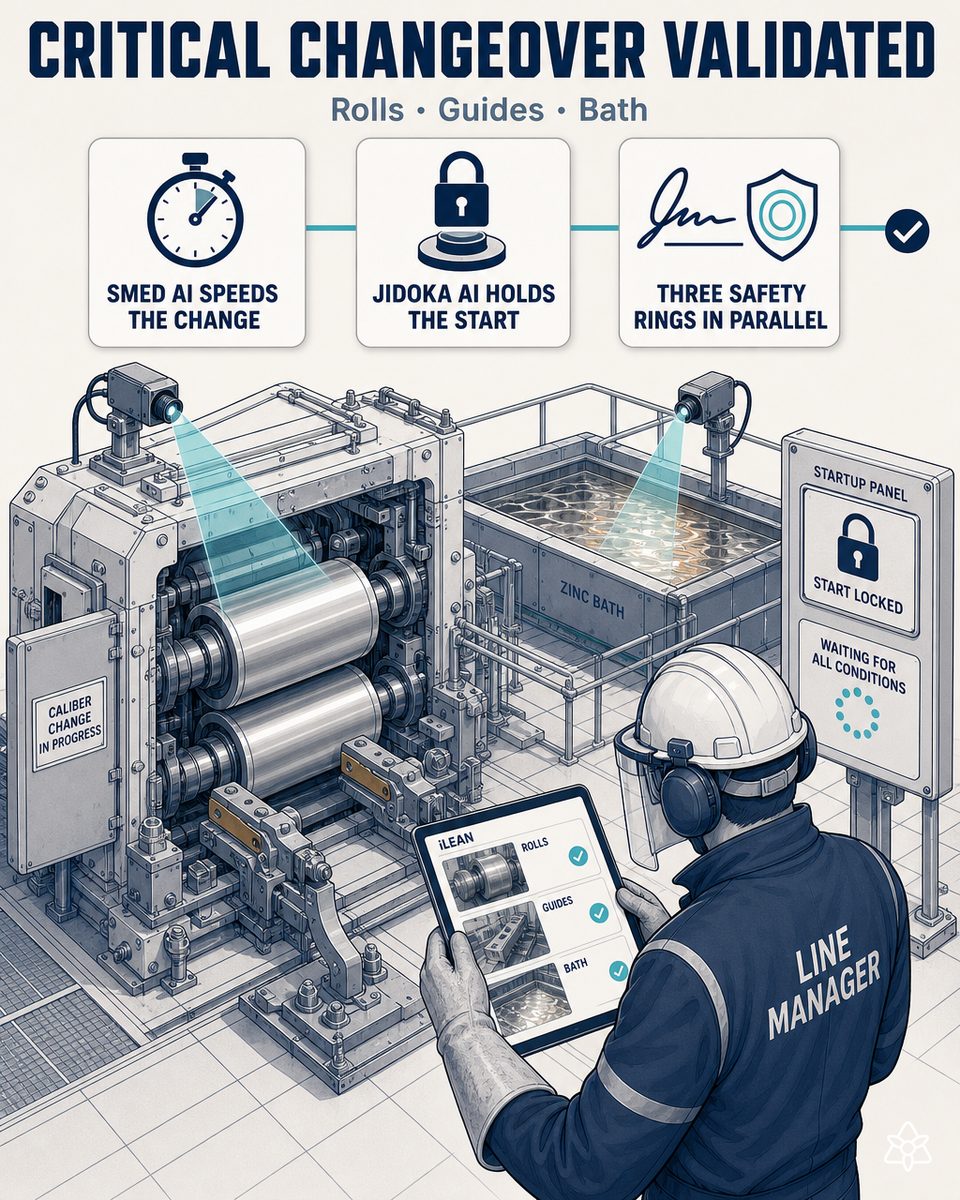
A rolling line changes caliber. A drawing line switches from construction steel to spring steel. The zinc bath demands temperature control and wiping thickness. iLEAN Edge places fixed cameras at each critical point, compares against the reference state and does not let the line start until all clear and the manager signs. Three safety rings active at every critical changeover.
JIT is decided at the changeover: if it is not fast and clean, the first stretch goes to scrap.
With the reference running steadily, a long steel mill is stable. The risk concentrates in the critical changeover: the caliber change in rolling, the switch from construction to spring steel in drawing, the zinc bath temperature and wiping thickness adjustment in galvanizing. JIT depends on those changes being fast and clean — when they are not, the entire downstream flow pays for it:
- If the start comes out dirty, the first stretch is scrapped — a misaligned guide, a roll with the wrong caliber or a crooked wiping turn the first meters of product into scrap before anyone notices, and the committed delivery slips.
- Releasing the changeover rests on a human signature with no structured visual evidence — the manager signs a checklist run through in a hurry between two references, with no objective record of the real state of each critical point.
- When it fails, nobody knows why it failed — with no per-point evidence, the later analysis is reconstruction from memory: every dirty start is argued about rather than explained, and the same failure returns at the next change.
A badly verified critical changeover translates into the same thing: startup scrap, net SMED time inflated by readjustments, penalized mill OEE and JIT delivery at risk. And if the destination is an automotive Tier 1, the dirty start does not stay at home: it becomes a claim.
Edge clears it point by point — JIDOKA AI does not let the mill start until all have said yes.
The critical changeover is not solved with a longer checklist for the line manager: it is solved by giving them objective visual evidence of each critical setup point before they sign the release, and by making the mill physically unable to start while that evidence is incomplete. That combination is Edge plus JIDOKA AI — verification of the setup, not of people.
Edge verifies each critical changeover point — rolls and caliber in the rolling stand, guides, drawing die, zinc bath, wiping. JIDOKA AI does not release the start until every camera clears. The manager signs on the visual evidence and the validated first stretch, not on a blind checklist.
The iLEAN pieces applied to the critical changeover:
- Edge — industrial cameras with CNNs trained to recognize "roll changed correctly", "guide aligned", "bath clean" and "wiping straight", fixed at the critical setup points: rolling stand, inlet and outlet guides, drawing block and galvanizing line. Each camera learns the reference state of that point for each caliber or steel grade and compares against it at every change.
- JIDOKA AI — receives each camera's verdict and acts as the start gate: while a single critical point is not cleared, the mill stays held. It is not an alert somebody can ignore under schedule pressure; it is an active block on the start until the evidence is complete.
- The manager's electronic signature on evidence — when every camera clears, the manager receives the summary with the photos of each critical point and signs the changeover release. The signature remains human and mandatory — what changes is that it is no longer given on a checklist run through in a hurry, but on structured visual evidence point by point.
- Three safety rings in parallel — Edge visual verification of the setup, validation of the first stretch of the incoming reference and the manager's electronic signature. No ring replaces another; every changeover is documented as an event for the evidence pack, ready for the customer or the audit without reconstructing anything weeks later.
Signing blind vs. signing on per-point visual evidence of the setup
| Aspect | Classic critical changeover | With iLEAN Edge + JIDOKA AI |
|---|---|---|
| Evidence the manager signs on | Signed blind, with a risk of a dirty start | Signed on per-point visual evidence, with the capture archived |
| Verification of rolls, guides and wiping | By eye, per checklist, with no objective record | A CNN at each critical point compares against the incoming reference state |
| Net SMED time | Extended by post-start readjustments after measuring the first stretch | −20 to −40% by avoiding post-start readjustments (estimate to be validated) |
| Startup scrap | First stretch to scrap on every doubtful change | Near zero — the start comes out clean first time |
| A camera that fails or cannot read | Assumed OK if nobody says otherwise | The block is held — absence of data is not a green light |
| Analysis when a changeover fails | Reconstruction from memory — nobody knows why | Event documented in the evidence pack: photo + Edge verdict + first stretch + signature |
Impact estimate for your plant — to be validated with your own numbers.
The block below is an estimate to be validated against your plant's actual data. We put it forward so the committee has an order of magnitude; we refine it during the assessment.
- Long steel line with daily critical changeovers: caliber change in rolling, grade change in drawing and zinc bath and wiping adjustment in galvanizing, each with its critical setup points.
- Edge + JIDOKA AI pilot on the critical changeover points (cameras plus start gate plus integration with the manager's signature and the first stretch validation). First value expected within 4 weeks.
- Estimated payback of 5 to 10 months, depending on the number of changes per day and the weight of the premium segment in the mix. Estimate to be validated against your data.
- Return levers: startup scrap reduced to near zero and higher OEE for the mill and the galvanizing line, because net SMED time drops between 20 and 40% once post-start readjustments are eliminated. Estimate to be validated.
- Protection of the automotive Tier 1 customer, who penalizes dirty starts: every change that starts clean first time takes risk out of the premium supply relationship. Estimate to be validated.
And the fair question from the line manager
"What if the camera clears a roll that is not actually the one for the incoming caliber, or the other way round, blocks the mill for no real reason?" — hallucination is a problem of free generation, not of anchored tasks. In tasks where the AI merely compares the current image of a critical point against its previously validated reference state — which is exactly what Edge does here — the best models brought the error below 1.5% [1]. And even then, the critical call is not made alone: JIDOKA AI holds the start, the first stretch confirms and the manager signs, seeing the evidence behind each point. iLEAN's three safety rings exist precisely for this — the AI proposes, the manager decides.
[1] OpenAI paper "Why Language Models Hallucinate", 2025 — on the reliability of AI in anchored tasks.
What people ask about the critical changeover with Edge and JIDOKA AI
What exactly is JIDOKA AI and how does it block the start after the change?
JIDOKA AI is the orchestration layer that turns the Edge cameras' verdict and the line manager's signature into a block on the mill start. It takes its name from the classic jidoka principle — stopping at the anomaly instead of letting it advance — applied by AI to the critical changeover of a long steel line: until it receives clearance from all the cameras at their critical points and the manager's electronic signature on that evidence, JIDOKA AI keeps the start held. The gate does not open because the production schedule is tight or because the change "has always been done this way"; it opens when the structured visual evidence of the setup is complete and signed.
How many cameras are needed and at which points of the line?
The usual range is three to five fixed cameras, one per critical point that changes with the setup: rolls and caliber in the rolling stand, inlet and outlet guides, the die in the drawing block and, on the galvanizing line, the zinc bath and the wiping knives. Each camera learns the reference state of that point for each caliber or steel grade in the catalog and compares against it at every change, not once per shift. The final number depends on your mill's critical point plan; these cover the elements whose wrong change turns the first stretch of product into scrap.
What happens if a camera fails or loses its reading during the change?
The system is designed to fail closed, not open. If a camera stops giving a valid reading — rolling dust on the lens, connection failure or framing drift — JIDOKA AI does not interpret the silence as OK: it records "point without valid reading — block held" and keeps the start held until the camera is repaired or the manager validates that point manually with their signature. Absence of data never translates into a green light; on a critical changeover it translates into more verification, not less.
How does Edge reduce net SMED time if it adds one more verification?
Because the verification is not added to the change: it replaces the post-start readjustments, which are what inflate net SMED today. In a classic change the mill starts, the first stretch comes out, it gets measured, the misaligned guide or crooked wiping is found, the mill stops and gets readjusted — and that cycle can repeat. With Edge, each critical point is compared against its reference state before starting, while the team executes the external SMED operations, so the first start is already the good one. The starting estimate is a 20 to 40% reduction in net SMED time from eliminating post-start readjustments — an estimate to be validated against your mill's data.
Is the manager's signature still required with Edge running?
Yes, always. Edge does not replace the human signature or the first stretch validation: it reinforces them. iLEAN keeps three safety rings active in parallel — Edge visual verification of each critical setup point, validation of the first stretch of the incoming reference, and the manager's electronic signature on that evidence. What Edge contributes is that the signature stops resting on a checklist run through in a hurry between two references: the manager signs on structured visual evidence point by point, captured at the moment of the change and archived in the evidence pack. No ring depends on another to exist.
More cases from this series
- Every heat ships with its audit dossier already madeEvery heat ships with its auditable dossier: charge mix, chemistry, rolling record and certificates,…
- The coil marker stitched to the active order, with no retypingHeat number, grade and customer travel from the active order to the coil marker with no retyping: the…
- The customer alert, read within seconds instead of hoursOrder changes, quality alerts and scrap supply delays are read, classified and cross-checked against the…
- The electric arc furnace panel already talks — without touching its PLCA camera reads the electric arc furnace panel and every heat carries its real energy and power-on curve…
- Heat startup in the melt shop, digitized with a photographThe heat startup sheet is photographed and the heat exists in the central system at zero latency: scrap…
- The lab spreadsheet poured into the ERP, without retypingChemistry and mechanical readings move from the lab spreadsheet into the ERP with no retyping — and…
SMED AI applied to your rolling mill — a 4-week pilot.
We work on your plant's real data, not ours. Assessment with no commitment.
Request estimated ROI within 48h ‹ See all 12 long steel cases See steel