The veteran wire EDM that finally talks
The workshop that machines horns often relies on a wire EDM that is fifteen or twenty years old: precise, critical for the horn slots, and fitted with a proprietary panel that has no connection. Cut time, wire breaks, parameters per part: it all appears on the panel and vanishes. Nobody can correlate that data with the horn's final frequency or with rework. iLEAN Connect places a camera pointing at the screen. OCR with an anchored model reads every change and structures it per part and order. The machine stays as it is; its control is never touched.
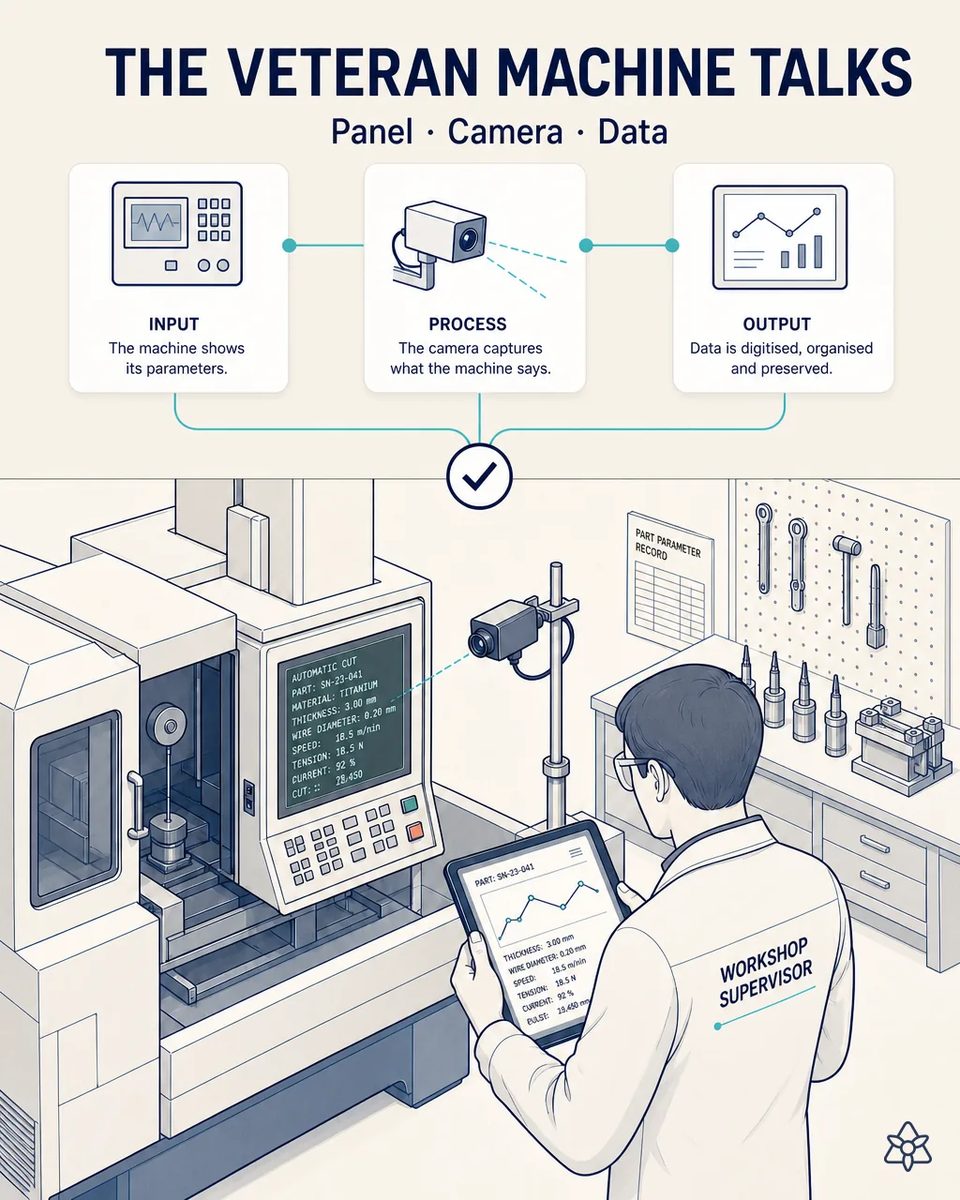
The machine that cuts the horn slots forgets every part it cuts.
The workshop that machines horns often relies on a wire EDM that is fifteen or twenty years old: precise, critical for the horn slots, and fitted with a proprietary panel that has no connection. Cut time, wire breaks, parameters per part: it all appears on the panel and vanishes. Nobody can correlate that data with the horn's final frequency or with rework.
- The horn workshop often relies on a wire EDM fifteen or twenty years old: precise, critical for slotted and block horns, and fitted with a proprietary panel with no network port.
- Cut time, wire breaks, wire diameter, tension, current and offsets per part appear on the screen and vanish when the next program loads. Nobody writes them down because nobody has the time, and the operator is already setting up the next titanium blank.
- When a horn comes off the tuning bench with its resonant frequency off target, nobody can check whether that part had three wire breaks or a different offset, so the rework is blamed on design or on luck.
- Replacing the machine to get data is a capital request nobody wants to sign for a machine that still cuts within tolerance.
Connect in photo mode on the panel — read from outside, the control untouched.
ILEAN Connect places a camera pointing at the screen. OCR with an anchored model reads every change and structures it per part and order. The machine stays as it is; its control is never touched. iLEAN links what it reads with the horn's work order in the ERP, so quality and engineering see the full history of every part.
The camera reads what the operator already sees, and nothing more. No retrofit, no network card, no change to the EDM's program: the machine keeps cutting exactly as it does today and its history stops disappearing. For the first time, each horn arrives at the tuning bench with its cutting record attached.
The silent EDM versus the EDM being read
| Aspect | Today | With iLEAN Connect |
|---|---|---|
| Parameters per horn | On the EDM screen, then gone | Stored per part and work order |
| Wire breaks during a slot cut | Remembered by the operator, if at all | Counted per part |
| Off-frequency horn at tuning | Cause never traced | Cross-checked with its cutting history |
| EDM control and program | — | Not touched |
| Engineering and quality access | Walk to the machine | Full history per horn |
| Replacing the EDM for data | On next year's capex request | Deferrable |
Before: panel data lost. After: machining history per horn.
Impact estimate — to be validated with your numbers.
The block below is an estimate to be validated against your plant's actual data. We put it forward so the committee has an order of magnitude; we refine it during the assessment.
- Estimated payback 5-10 months.
- Replacement capex for the EDM can be deferred, because the reason for replacing it was data, not precision.
- The link between cutting parameters and horn rework becomes visible for the first time, so the next design or the next offset change is decided with evidence rather than with the most senior operator's intuition.
- Engineering can compare the cutting history of good and reworked horns of the same design instead of arguing from memory.
Payback 5-10 months · replacement CAPEX deferred (estimate to be validated). Replacing the machine can be deferred, and the link between parameters and rework becomes visible. Estimated payback of five to ten months; an estimate to be validated.
And the fair question from the production manager
“A camera reading an old screen will make mistakes.” — the screen is fixed, the fields sit in known positions and every value has an expected physical range, which makes it an anchored task where the best models drop below 1.5% error [1]. A frame whose wire tension or current falls outside the possible range is discarded rather than stored, and the first week is checked against manual readings before anyone relies on it.
[1] OpenAI paper "Why Language Models Hallucinate", 2025 — on the reliability of AI in anchored tasks.
What people ask about reading the wire EDM panel
Do we have to open the EDM control or install software on it?
No. The camera sits on a stand in front of the screen and reads it from outside. The control, the program and the machine's warranty status are left as they are. Installation takes hours and the EDM keeps cutting while it is done.
How does it know which horn is being cut?
It reads the part or program identifier shown on the panel and links it to the horn's work order in the ERP. If the panel does not show it, the operator scans the order once at the start of the cut. Nothing else is asked of the EDM operator during the shift.
Can it relate wire breaks to the horn's final frequency?
Yes, that is the point of the case. With the cutting history per horn and the tuning bench result, engineering can see whether off-frequency horns share a cutting pattern, such as more breaks or a different offset. That correlation is what turns rework from bad luck into a parameter that can be corrected.
What if the panel shows several screens or menus?
Each screen layout is learned at commissioning. When the operator switches to a menu that carries no process data, those frames are simply ignored. Alarm screens, on the other hand, are read and logged, because a wire break alarm is exactly the event engineering wants to count.
Does it work on other old machines in the horn shop?
Yes, the same pattern serves a lathe or a grinder with a closed panel. We start with the EDM because the horn slots are where geometry and frequency are decided, and where an off-target horn costs most to re-cut.
Tell us how old the EDM that cuts your horn slots is.
We work on your plant's real data, not ours. Assessment with no commitment.
Request estimated ROI within 48h ‹ See all cases of ultrasonic welding equipment See metal fabrication and capital equipment