Leak detection in meat vacuum packing — the bad bag is found on the line, not on the shelf.
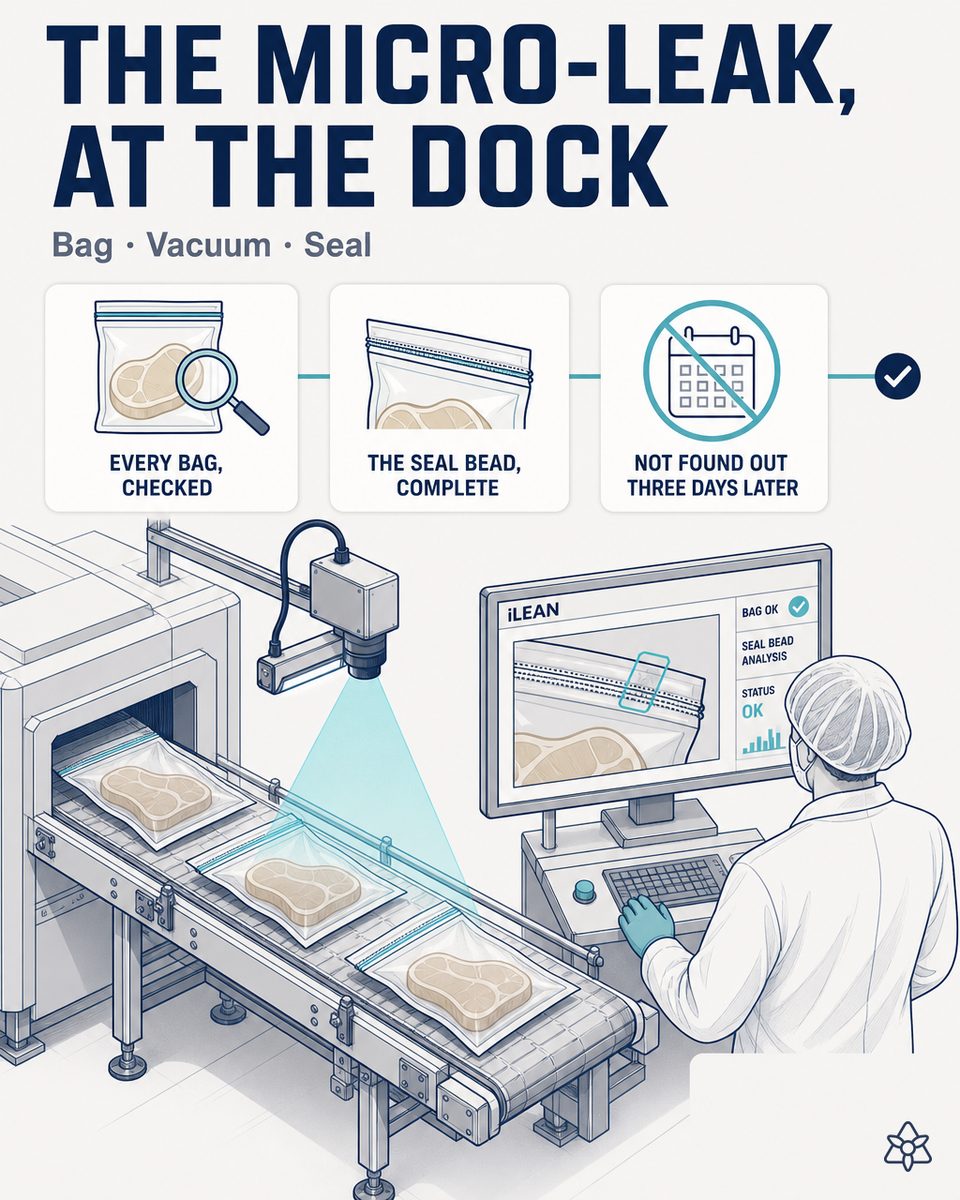
A vacuum bag with a microleak is product lost within 3 days — the customer opens it and smells that something is off. iLEAN Edge finds it first: it combines vision on the seal, real vacuum level and, when needed, differential pressure, and ejects the bag at the thermosealer outfeed. The person signs when it matters.
The defect that doesn't show up on the line — it shows up at the customer's home.
Vacuum packing in the meat industry has a cruel trap: the bag with a microleak leaves the line looking perfect. The trap is that oxygen creeps in slowly, the product bloats and turns acidic over the days, and the defect explodes on the supermarket shelf or in the customer's fridge. By then, the cost chain is brutal: returned product, reverse transport, a full batch recall if the supermarket demands it, and brand damage that weighs more than the invoice.
Manual inspection at the outfeed works reasonably for the gross leak — a clearly dirty seal, an obvious fold — but it misses the two worst ones: the microscopic leak the eye can't see and insufficient vacuum that only shows when you squeeze the bags one by one. And at 60-120 bags/min, nobody squeezes one by one. Statistical sampling finds the problem when every box is already on the pallet.
And the thermosealer operator knows it — but they're loading the next round. The quality lead knows it — but they're in another room. The information reaches the person who should act too late.
iLEAN doesn't replace the thermosealer — it puts eyes on the outfeed.
Leak control doesn't require changing the machine, but closing the dead zone between the thermosealer (which only reports its cycle) and palletizing (which assumes the bag is good). iLEAN acts as the putty between the two: an Edge terminal sees every bag, the agents cross-check that data against recipe/SKU/film-roll change, and the decision stays with the person when needed.
Edge sees every bag at the outfeed. If the seal, the vacuum or the film don't add up, it ejects before palletizing. Connect captures the shift context. The agent delivers root cause at the end of the day. The person decides.
The iLEAN pieces applied to leaks in meat vacuum packing:
- Edge — a vision (CNN) terminal over the line, right at the thermosealer outfeed. It inspects every bag: perimeter seal integrity, real vacuum level read from the chamber, no folds or hairs in the joint. Actuator in milliseconds: if the bag doesn't pass, it goes to the rework lane. It works without a network. If the plant loses WiFi, Edge keeps inspecting and ejecting, because what's critical can't depend on connectivity.
- Connect — captures the context that gives the rejections meaning: which recipe is running, which film roll has been loaded, which operator is on the line, which SKU is being made. It pulls it from the ERP, the MES, the thermosealer's PLC or an old panel nobody had integrated. And if an incident arrives from outside (a retailer writes “return for bloating on batch X”), it enters the system at second zero and the agents cross-check it against the packing day/shift.
- Agent — at the end of the shift, it delivers a prioritized root-cause dossier: which SKU concentrates the rejections, which film roll correlates with more leaks, which shift needs a short training on product loading. It's not a report that lands Monday at 9; it's available whenever the quality lead needs it, with a photo of every ejected bag and its defect code.
Sampling + eyeballing vs. inspecting every bag with iLEAN
| Aspect | Sampling + operator visual inspection | With iLEAN Edge + Connect + Agent |
|---|---|---|
| Coverage | By sampling, assumes the rest | Every bag, no exceptions |
| Microleak | Discovered on the shelf or in a return | Detected in line via vacuum deviation + seal vision |
| Dirty or folded seal | Operator's eye, depends on the shift | Trained CNN, same criteria across shifts |
| Root cause | Weekly meeting, partial data | Per-shift dossier: SKU, film roll, operator, machine |
| SKU / format change | The operator remembers the recipe | Edge switches the active model automatically per recipe |
| Retailer return | “We'll look into it”, weeks | Immediate cross-check with that day's shift/roll/batch |
Impact estimate for your plant — to be validated with your numbers.
The block below is an estimate to be validated with the specific data of your plant. We put it forward so the committee has an order of magnitude; we refine it during the diagnostic.
- Mid-sized meat plant, 2-4 thermosealers, a mix of thermoforming and skin pack, current bloating-return ratio known per SKU.
- Edge pilot on one thermosealer (camera + lighting + actuator + integration with the MES recipe/SKU). First value expected within a few weeks: consistent detection of defective seals and low-vacuum bags.
- Bloating returns down ≥ 30% on the pilot SKUs, and a clear drop in the associated retailer complaints. Conservative estimate; the ceiling depends on how much was due to avoidable defects vs. handling after the product left the plant.
- Indicative payback between 4 and 9 months, depending on the average cost of a return and the volume of vacuum-packed SKUs. The hard lever is the combination of recovered scrap + avoided returns + a root-cause dossier that shortens the improvement cycle.
And the standard the sector is heading toward
Meat isn't automotive, but the direction of the curve is: in automotive the demanding standard is in the order of 25 PPM (parts per million) of defects shipped to the customer[1]. Meat is on its way to similar demands because the big retailers are tightening their return SLAs. Whoever starts now with 100% vision inspection reaches that curve with the road already built, not against the clock.
And the quality director's reasonable doubt: “What if the AI ejects good bags?” — hallucination is a problem of free generation, not of anchored tasks like reading a bag and comparing it against a pattern. In anchored tasks the best models brought error below 1.5%[2]. And even so, what's critical is never decided alone: the system flags, a person validates in the cases the customer decides deserve a human signature.
[1] Automotive quality standard in the order of 25 PPM — source Symestic.
[2] OpenAI paper “Why Language Models Hallucinate”, 2025 — on the reliability of AI in anchored tasks.
What people ask about leak detection in meat vacuum packing
How does it detect microscopic leaks in a vacuum bag?
iLEAN Edge combines computer vision (CNN) on the bag at the thermosealer outfeed with the signal from the vacuum chamber and, when in doubt, with differential pressure on the bag. Vision detects wrinkles in the seal, folds of poorly stretched film, a hair or product residue caught in the joint. The vacuum chamber reads the real vacuum percentage per bag and compares it against its recipe curve. If a bag breaks the thresholds, Edge fires the ejector in milliseconds, before palletizing.
Does it work equally well for skin pack and deep thermoforming?
Yes. The physical piece is the same (Edge terminal + camera + actuator); what changes is the vision model and the thresholds for each format. Skin pack requires verifying that the film has bonded against the product without bubbles and that the mold cut is clean. Deep thermoforming requires verifying the film draw, the perimeter seal and the product height against the cavity. The operator configures the format per SKU and the system switches the active model at the recipe change.
Automatic rejection — yes or no?
By default yes, configured per plant. When Edge detects a bag outside the threshold, the ejector separates it from the main line into a rework lane, without stopping the overall pace. In plants that prefer human validation (for example, on export batches with a very strict customer), the system flags the bag, sends a notice to the quality lead through Connect and waits for a human signature before discarding or recycling. The plant decides the level of autonomy — iLEAN's three rings are designed so that human validation can happen when it matters.
How many bags per minute can it inspect?
Edge inspects at the thermosealer's nominal pace, not below it. In chilled meats with deep thermoforming that means tens to hundreds of bags/min, with margin to spare because vision + actuator work in milliseconds. Inspection is not the bottleneck; the bottleneck remains the thermosealer itself and the manual loading of product, and Edge locks onto that rhythm without slowing it down.
Does it generate root-cause statistics per shift?
Yes. Every ejected bag is recorded with a photo, a defect code (dirty seal, fold, low vacuum, estimated microleak) and the shift context: recipe, operator, machine, time. iLEAN's agents cross-check that data at the end of the shift and deliver a prioritized root-cause dossier: which SKU concentrates the rejections, on which shift and machine, and whether it correlates with film-roll or product-batch changes. The person decides what to do — the agent proposes, it doesn't impose.
Tell us your case and in 48h we'll send you the estimated ROI of this AI project for your vacuum packing.
We work on your plant's real data, not ours. Diagnostic with no commitment.
Request estimated ROI in 48h ‹ All meat industry cases See food industry