SMED on presses with AI — every changeover minute you lose again is a production shift that never existed.
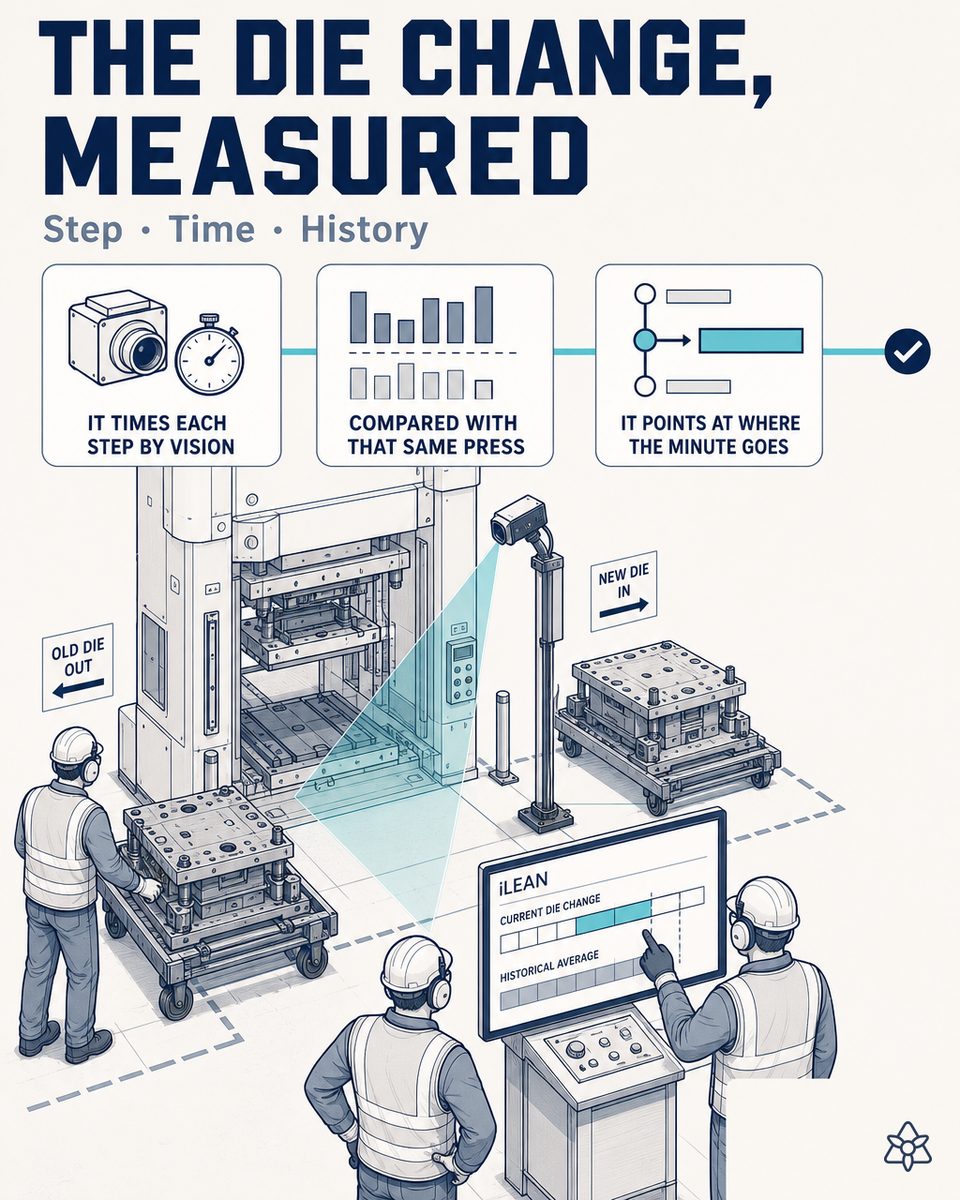
The die change on a press is a closed window of inactivity. iLEAN times every step by vision, compares it with the history of that same press and part number, and proposes an optimization for the next shift. A person decides what to change — the line does not decide on its own.
SMED was done once, documented, and left hanging on the wall.
The operations manager of a press shop tells it the same way in every plant: there was a SMED campaign a few years ago, tooling carts were built, time studies were run with a stopwatch in hand, part X went from 90 minutes down to 35, everyone applauded. And then this happened:
- Real changeovers started drifting away from the target time, little by little, with nobody knowing why — the metric lived on a whiteboard nobody looked at.
- Every shift crew does the changeover their own way; whoever does it well, nobody knows why, because nobody has time to time one every couple of weeks.
- When a new part number comes in, the procedure gets improvised on the spot; the learning never accumulates.
- Across similar presses, changeover times for the same part number vary by 30-50% with no documented explanation.
The knowledge of the veteran who could do the changeover in 18 minutes lives in the veteran's head. The day he retires, it walks out with him. And SMED without continuous measurement is not Deming — it is an old photo on a wall.
iLEAN does not take SMED away from you — it keeps it alive, shift after shift, with nobody timing by hand.
Traditional SMED fails for the same reason any continuous improvement fails without continuous measurement: nobody has time to look at the data every shift. iLEAN acts as the putty that seals the crack between the methodology (which you already know) and real operations, without replacing the shift lead or the continuous improvement team.
Vision sees the changeover step by step. The agent compares it with the history and across presses. The Brain proposes a concrete improvement for the next shift. The person decides what to change.
The three iLEAN pieces applied to SMED on presses:
- Vision — a terminal with a camera and a convolutional neural network on each press. It detects the changeover events without the operator writing anything down: last good part, stop, die out, die in, first good part. It timestamps every step, identifies the part numbers going in and out, and records the shift crew. It works locally: if the plant loses its network, it keeps recording the events.
- Agent — cross-references each changeover with every previous changeover on that same press and part number, identifies the systematic bottleneck (not the isolated worst case) and compares it with the internal benchmark of the other presses in the shop. The operational question it answers: “what did the night crew do differently to get the changeover done in 22 minutes?”.
- Brain — synthesizes the improvement proposal for the next changeover in shop-floor language, not jargon: “in this changeover, the 4 minutes waiting for tooling are an internal task that can become external by preparing the cart during the last batch”. The person decides; the improvement is applied; the next changeover measures whether it worked.
Stopwatch SMED vs. living SMED with iLEAN
| Aspect | Traditional SMED | With iLEAN Vision + Agent + Brain |
|---|---|---|
| Measurement frequency | One-off campaigns, time studies once a year | Every changeover, on every press, automatically |
| How it gets timed | A person with a stopwatch, once a quarter | Vision detects the events and timestamps them on its own |
| Benchmark across presses | The shop supervisor's anecdote | An objective dashboard, same part number across presses |
| Learning across shifts | Whatever the veteran passes on | Cross-referenced history, a concrete proposal for the next one |
| Identifying internal→external tasks | A workshop once every few years | The agent detects candidates at every changeover |
| Traceability for an IATF audit | Rebuilt by hand | An automatic dossier per changeover |
Impact estimate for your plant — to be validated with your numbers.
The block below is an estimate to be validated with the specific data of your shop. We put it forward so the committee has an order of magnitude; we refine it during the diagnostic.
- A shop with 4-8 multi-SKU presses, several changeovers a day, SMED documented but with no continuous measurement in recent years.
- A Vision pilot on 1-2 presses covering the most frequent changeover family. First value expected within a few weeks: the first timing dashboard cross-referenced across presses and shifts shows up from day one.
- Expected reduction in total changeover time of ≥30% in the first months, a defensible floor — the real ceiling is usually quite a bit better when the shop has gone a long time without timing anything.
- Indicative payback between 4 and 9 months, depending on the press hourly cost and the changeover frequency. The hard lever: every minute recovered on frequent changeovers turns into an extra production shift, not into a faster line.
- A recurring benefit that does not go into the direct ROI but carries weight: the veteran's know-how is captured as a pattern and can be repeated by the next shift.
And the shop supervisor's reasonable doubt
“The camera is filming the crew — is this about checking up on people?” — no. iLEAN does not track people; it sees process events. What it measures is the changeover as a system, not who performs it. What comes out of the analysis is “this step is an internal-to-external candidate on this press”, not “this operator took X minutes”. The dashboard the agent assembles is for the continuous improvement team, not for HR — and that is the vote for Future B: technology that gets more out of the people you already have, without replacing them and without making them the object of the measurement.
What people ask about SMED on automotive presses with AI
How does it time the die change automatically?
iLEAN Vision (a terminal with a camera and a convolutional neural network) sees the press the way a shift lead sees it. It detects the key events of the changeover — last good part, press stopped, old die out, new die in, first good part — and timestamps them to the second. The operator writes nothing on a sheet: the system builds the step-by-step breakdown on its own. What matters is not the timing itself, it is that every changeover becomes comparable with every previous one on the same press and the same part number.
What about mechanical vs. hydraulic changeovers?
The SMED methodology is the same — separate internal tasks (with the press stopped) from external ones (with the press running) and convert as many internal tasks as possible into external ones — but the physical steps change. In a classic mechanical changeover, Vision detects unbolting the die, the tooling swap and bolting down the new die. In a changeover with quick-clamp hydraulic systems, the events are different (hydraulic block coupling, pressurization). The system is trained on your press's real events, not on a generic pattern. The methodology does not change; the images that trigger it do.
Does it work in a multi-press shop?
Yes — that is the normal case. Each press gets its own Vision terminal; the Brain receives every timing and cross-references them. That enables the single most useful data point for the operations manager: an internal benchmark between presses on the same part number. If press 3 changes over part X in 18 minutes and press 5 takes 32, the difference is not the press: it is the sequence. The agent identifies which steps have been eliminated or converted to external on press 3 and not yet on press 5, and proposes the concrete improvement for the next changeover.
Does it learn from each press's history?
Yes. Every changeover is recorded step by step, along with the part numbers going in and out, the shift crew and the timed events. The agent cross-references that history with current changeovers and learns which steps are the systematic bottleneck (not the isolated worst case) on each press. That turns SMED into a continuous Deming cycle: plan the improvement for the next changeover, do it, check it against the timing of the following one, act. The machine keeps the cycle turning shift after shift; the person brings the judgment about what to change.
What is the typical time reduction?
It depends a great deal on where you start — a shop that ran SMED five years ago and then let it slide is not in the same place as one that times a changeover by hand now and then. As a defensible floor for the committee, a ≥30% reduction in total changeover time in the first months is realistic when two conditions are met: the press runs frequent changeovers (multi-SKU) and the operations team wants to see the data. The payback does not come from the minute saved, it comes from the extra production shift that time frees up. We send you the estimated ROI in 48h with your press's real data.
More cases in automotive
- Industrial AI in passive safety manufacturing plants12 real industrial AI cases in airbag, seat belt and steering wheel plants: unit traceability, in-line…
- Automotive PCB defects — classic AOI does not learn the new component; iLEAN Vision does.iLEAN goes beyond classic AOI: it detects false solder joints, rotated or missing components and learns…
- Industrial artificial intelligence for automotive plastic interior module plantsTwelve real cases of AI in injection molding and assembly plants for instrument panels, door trims and…
- Industrial AI in automotive seating plantsTwelve industrial AI use cases grounded in plants that build automotive seating just-in-time and…
- Industrial AI in automotive wheel plants12 real AI cases for steel and aluminium wheel plants: paperless capture, in-line vision inspection and…
- Industrial AI in automotive wire harness plantsTwelve industrial AI cases landed on wire harness plants: shop-floor capture, in-line vision and agents…
Tell us your case and in 48h we'll send you the estimated ROI of this AI project for your press shop.
We work on your plant's real data, not ours. Diagnostic with no commitment.
Request estimated ROI in 48h See automotive