Kanban: digital pull flow powered by industrial AI
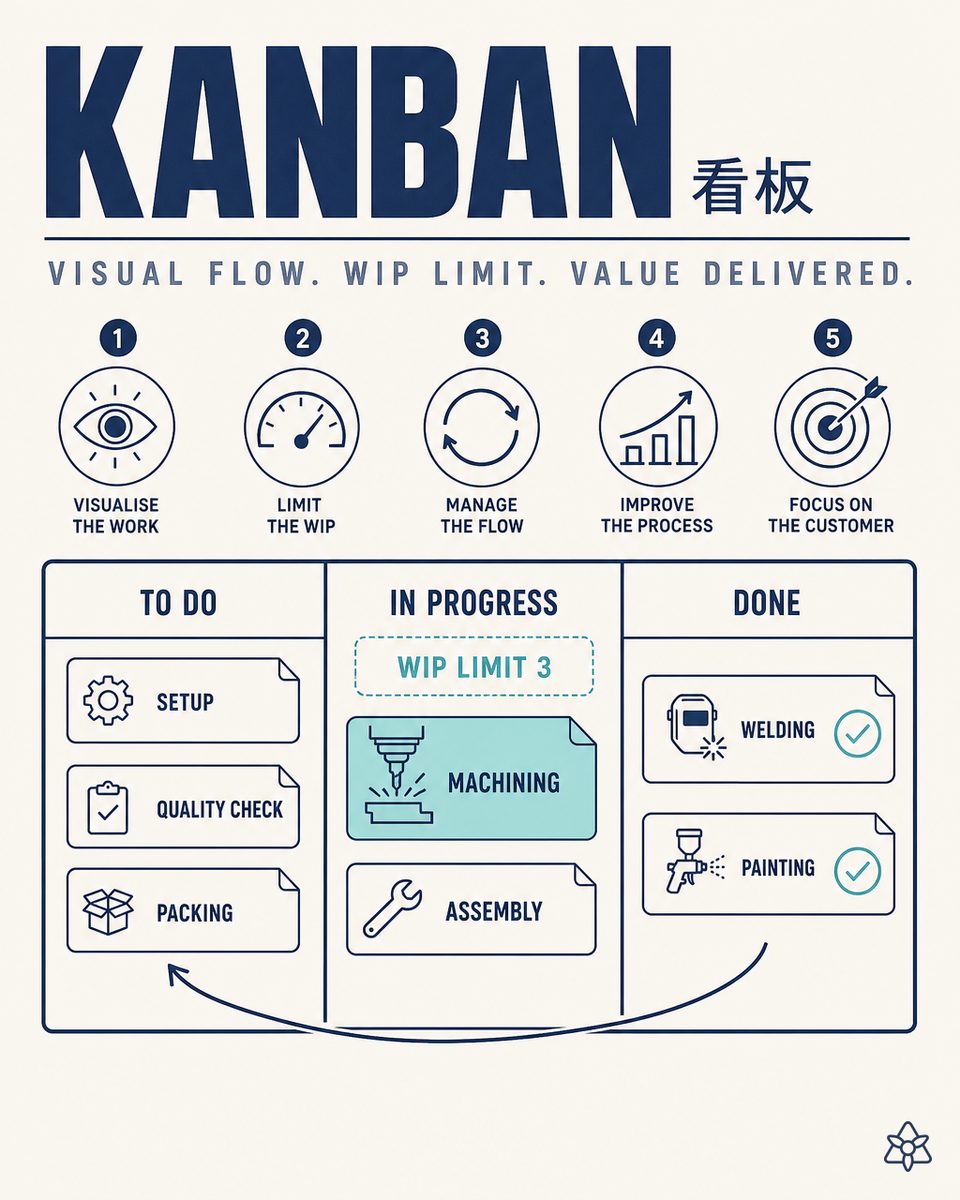
Kanban is a visual workflow management system that uses cards to signal what to produce and when — a pull system where production is triggered by real demand, not by a theoretical plan.
Tracking it on paper? Snap a photo and see it digitized
Whatever the sheet —a log, an audit, a shift report— the AI agent learns its boxes from the first photo, reads it and stores it in your plant memory, where you can ask it questions from your phone.
Kanban on the floor — more than a board
Kanban (看板, "board" in Japanese) was born at Toyota in the 1950s as a visual answer to an operational problem: how to prevent a cell from producing more than the next can absorb. The answer: physical cards that travel with the material and authorize production of the next unit only when the current one has been consumed.
Sixty years later, the principle is intact. What changes is the medium: cardboard cards become digital cards with cell-level traceability, WIP-limit alarms (Work In Progress) when a bottleneck forms, and notifications to the upstream operator the moment the downstream cell needs the next part.
iLEAN doesn't replace the method — it brings it into the 21st century.
Every Lean methodology was born to solve an information problem: where stock is, which machine is failing, what changed shift-to-shift. When information is paper, methods are rituals. When it's live data, they become the actual engine of the plant.
Classical method tells you what to measure. The IRIS system guarantees the measurement reaches whoever decides, the moment they decide — without anyone typing it in.
The three capture layers applied: Connect (photo, voice, email, WhatsApp), Edge (computer vision on the line) and Integrations (ERP/MES/SCADA/PLC). On top of that unified information, specialized agents serve the exact context to each person on the floor.
Physical Kanban vs. digital Kanban with iLEAN
| Aspect | Physical Kanban | Kanban with iLEAN |
|---|---|---|
| Card | Laminated cardboard | Digital card with code + photo |
| Flow | Operator carries card by hand | Automatic notification to previous station |
| WIP limit | Number of physical pockets | Alarm when WIP exceeded |
| Traceability | Not recorded | Cycle time per card and cell |
| Configuration change | Reprint and relaminate | Board edit, instant rollout |
What people ask about industrial Kanban
What is Kanban?
Kanban is a workflow management system based on visual cards that signal what to produce and when. It's the classical implementation of the pull concept in Lean: production is triggered by real downstream demand, not by a theoretical plan that may drift.
How does industrial Kanban differ from software Kanban (Jira, Trello)?
Software Kanban (Jira, Trello, Asana) borrows the visual principle but applies it to engineering or management tasks. Original industrial Kanban manages physical material flow between production cells, with cycle times, batches and machine constraints. Same philosophy, different contexts.
How does iLEAN digitize a Kanban system on the plant floor?
iLEAN replaces cardboard cards with digital cards bearing a unique code that travel with each batch. When a cell consumes the last of its batch, a notification automatically fires to the upstream cell. WIP limits are configurable alarms. All traceability is recorded — cycle times, waits and bottlenecks visible on a live dashboard.
Do I still need physical cards or is it all digital?
It's your call. Many plants keep the physical component (operators still see and handle a card) and add the digital layer on top — the card has a QR scanned on cell transit. Others remove paper entirely. iLEAN supports both.
Does Kanban work in any manufacturing sector?
Kanban works where there's material flow with sequential stages — automotive, food, pharma, electronics, discrete-batch chemistry. Where it doesn't fit is continuous production without discrete batches (refinery, power generation): there, other pull mechanisms are used.
Tell us about your plant. We'll tell you how we'd do it.
25 years applying Lean in real plants. Free diagnostic conversation.
Request demo See Lean Manufacturing