JIT with a non-compatible supplier — between Toyota purity and European reality there is a dynamic buffer.
JIT with a non-JIT supplier ends in a line stoppage — or in a uniform stock cushion that throws away all the discipline Lean is built on. iLEAN calculates a dynamic buffer per supplier based on its real lead time, its variance, the cost of stopping the line and the cost of storing the part. Stock where it hurts; zero where it does not.
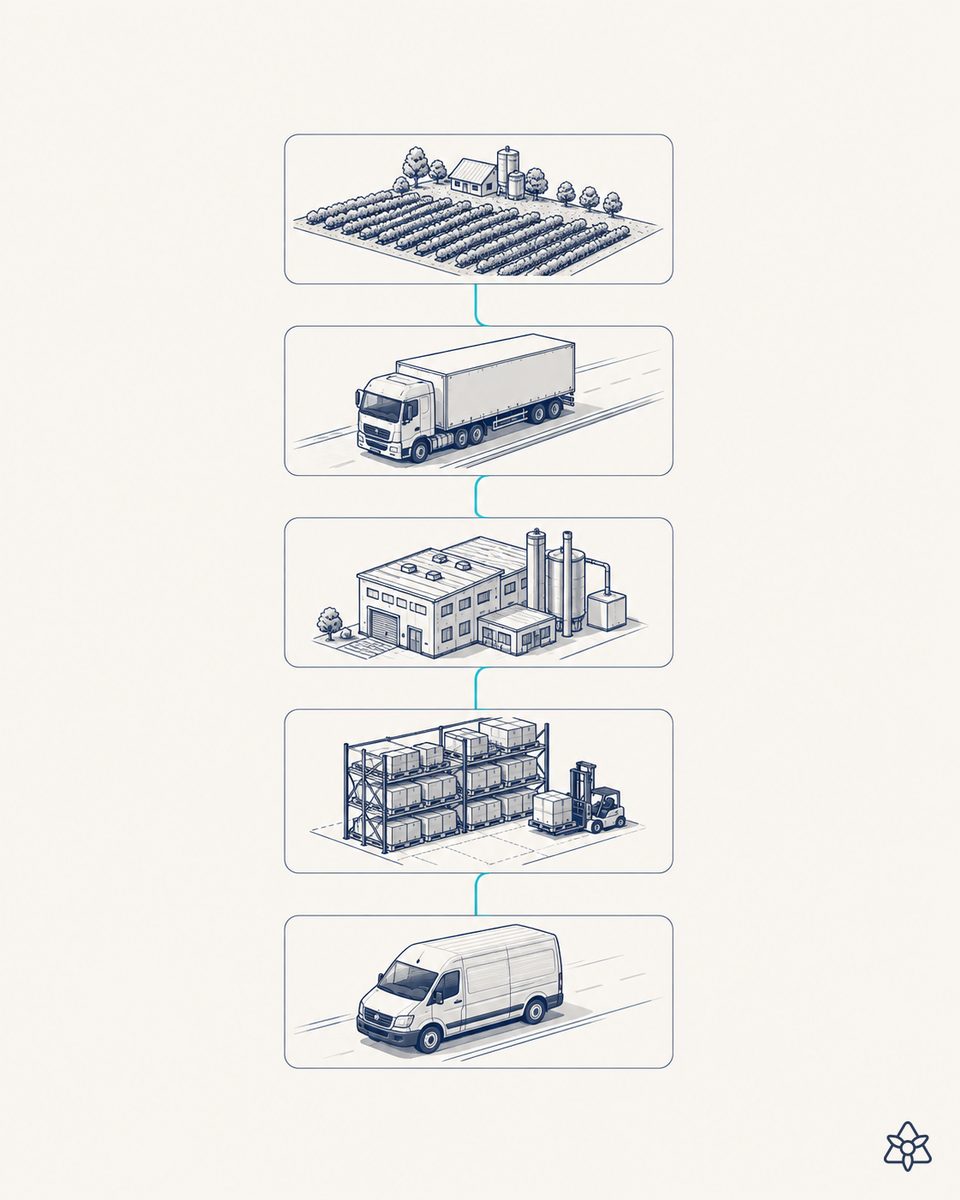
The plant runs JIT. The supplier of the critical part does not.
Any European assembly plant that has tried pure Toyota JIT has lived through this. Three or four strategic suppliers are aligned: short lead time, frequent deliveries, stable quality. But there is always one that is not: the cast part made by a single supplier in Asia, the electronic component with a chronic shortage, the subassembly from the small local supplier that delivers when it can. And that single non-JIT supplier forces one of two bad options:
- Hold a uniform safety stock across every part number so the line never stops. It ties up capital, inflates the warehouse and goes against everything Lean teaches.
- Keep pure JIT and take the risk. Every so often the line stops because one part ran out, and the operational damage eats months of stock savings.
The operations director knows it. The planner knows it. And the usual choice is the first one (the uniform cushion) because the second one scares the committee more. The result: operationally the plant drifts away from real JIT and towards theatre Lean — the poster on the wall, the warehouse full.
The backdrop does not help: ocean freight, the backbone of any long chain, went from roughly 1,500 USD per container to more than 20,000 at the 2021 peak, spiked again in 2024 with the Red Sea crisis and then fell on overcapacity [3]. Volatility breaks classical JIT — but it also breaks the uniform cushion, because a cushion sized for the normal situation gives no protection in the extreme one.
iLEAN does not break JIT — it adds a buffer that breathes with each supplier's reality.
JIT does not fail because of the methodology. It fails because the real supplier data (measured lead time, variance, early warning signals) lives in islands and the planner has no time to process it supplier by supplier. iLEAN acts as the filler between the ERP that knows the order, the supplier that knows its own reality and the warehouse that suffers the consequence.
Connect captures the supplier signal (email, messaging app, transcribed call). Brain calculates the dynamic per-supplier buffer every week. The agent alerts the planner when something moves — the person signs.
The three iLEAN pieces applied to JIT with a non-compatible supplier:
- iLEAN Brain — the calculation engine. It combines, per SKU × supplier: real measured lead time, historical variance, line-stoppage cost of that part, cost of storing it. It calculates the target stock level and recalculates it every week with fresh data. It is not a static ERP min/max — it is a dynamic target.
- iLEAN Connect — external capture. The information that gets ahead of a supplier problem almost never arrives through a sensor: it arrives in an email from the sales rep ("there was a fire in the warehouse"), a message from the carrier ("the truck is not leaving today"), a news item from the country of origin. Connect captures the channels — email, messaging apps, transcribed calls — and puts them into the system at second zero, with nobody forwarding anything.
- iLEAN Agent — it coordinates. When fresh data moves the target buffer, the agent alerts the planner, proposes the action (place an early order, redistribute between customers by SLA, contact the alternative supplier) and drafts the reply. The person signs. The system does not buy without a signature.
JIT with a uniform cushion vs. JIT with an iLEAN dynamic buffer
| Aspect | Classical JIT with safety cushion | With iLEAN Brain + Connect + Agent |
|---|---|---|
| Safety stock per SKU | Same percentage across every part number | Sized by the supplier's real risk |
| Reaction to a supplier delay | Email from the sales rep → meeting the next day | Connect reads it at minute zero, Brain recalculates, agent alerts |
| Total tied-up stock | Inflated by a uniform worst case | Typical reduction of 30% or more (estimate to be validated) |
| Line stoppages from stockouts | Low but not zero, with no traceability of cause | Significant reduction, with documented root cause |
| Visibility for the committee | The planner's monthly spreadsheet | Live dashboard: SKU × supplier × risk |
| Knowledge across plants | Each plant manages its supplier alone | Cross-plant data on shared suppliers |
Impact estimate for your plant — to be validated with your numbers.
The block below is an estimate to be validated with the actual data of your supply chain. We lay it out so the committee has an order of magnitude; we refine it during the diagnostic.
- Assembly plant with a JIT customer (automotive tier-2, industrial electronics, appliances), 80-200 active part numbers, 20-60 suppliers, of which 5-15 are not JIT-compatible (long lead time, high variance or both).
- Deployment of iLEAN Brain + Connect + Agent on top of the purchasing module. First value expected within a few weeks: the first buffer recalculation lowers total tied-up stock on the over-sized part numbers and raises it on the genuinely exposed ones.
- Indicative payback between 4 and 9 months, hard levers: reduction of total tied-up stock (capital released) plus reduction of line stoppages from stockouts (operating cost avoided).
- A reasonable total stock reduction to present to the committee: 30% or more. Service reliability improves at the same time. We measure it before and after on your real supply chain.
And the operations director's reasonable doubt
"What if the AI gets it wrong and leaves the line without a critical part?" — hallucination is a problem of free generation, not of anchored tasks. Calculating a buffer from measured lead time, variance and stoppage cost is the anchored task par excellence: on this kind of task the best models brought the error below 1.5% [1]. And even so, the critical call is never made alone: the agent proposes the order, the planner signs. The system does not buy without a human signature.
[1] OpenAI paper "Why Language Models Hallucinate", 2025 — on the reliability of AI in anchored tasks.
[3] Ocean container freight volatility (Drewry / Freightos Baltic Index, 2019-2026).
What people ask about JIT with a non-compatible supplier
How is the dynamic per-supplier buffer calculated?
iLEAN Brain combines four variables per supplier: (1) real historical lead time (not the one committed in the contract, the one measured at the plant); (2) lead time variance — a supplier that always delivers in 5 days needs less buffer than one swinging between 3 and 9 days; (3) cost of a line stoppage if that part is missing; (4) cost of storing that part. The result is a target stock level per SKU and per supplier, recalculated every week with fresh data. It is not a static ERP min/max — it is a dynamic target that breathes with the supplier's reality.
What about suppliers with highly variable lead times?
That is exactly where the dynamic buffer gives the most leverage. iLEAN Connect captures the early signals: a heads-up message from the supplier, an email from the shipping line about a delay, noise in the local press of the country of origin. Brain feeds them into the buffer calculation in hours, not weeks. And the agent drafts a reply to the supplier or an alert to the planner through the same channel. The person signs off before it is sent — the reply never goes out on its own.
Does it work in multi-country operations with long chains?
It works, and that is where it shows most. Ocean freight volatility went from roughly 1,500 USD per container to more than 20,000 at the 2021 peak, spiked again in 2024 with the Red Sea crisis and then fell on overcapacity. That volatility breaks classical JIT. iLEAN does not solve the volatility — it turns it into operational information: the Asian supplier's buffer adjusts automatically when lead time rises, and again when it comes back down. JIT does not break; it adapts.
Does it reduce total stock or increase it?
It reduces it in aggregate. Classical JIT with non-compatible suppliers is held together with a uniform safety cushion across every part number — because nobody has time to differentiate. iLEAN concentrates the buffer where the real risk sits (the supplier with the highest variance, the part with the highest line-stoppage cost) and removes it where it is not needed. Total stock goes down; service reliability goes up.
Does it help if we manufacture for several customers with different commitments?
Yes, and it is a common scenario. Each customer has its own committed service level (OTIF, delivery window, late penalty). The dynamic buffer is calculated by the combination part number × supplier × customer, so the customer with the strictest SLA consumes the buffer first and the customer with a flexible SLA absorbs the initial variability. iLEAN does not decide the split on its own — it proposes, the planner signs.
Tell us what your supply chain looks like and in 48h we will send you the estimated ROI of JIT with a dynamic buffer.
We work on your plant's real data, not ours. Diagnostic with no commitment.
Request estimated ROI in 48h See the JIT guide