5S: visual order and discipline, digitized
5S is the Lean methodology that organizes the workplace in five steps — Seiri (sort), Seiton (set in order), Seiso (shine), Seiketsu (standardize), Shitsuke (sustain) — so every tool has its place and every anomaly is visible at a glance.
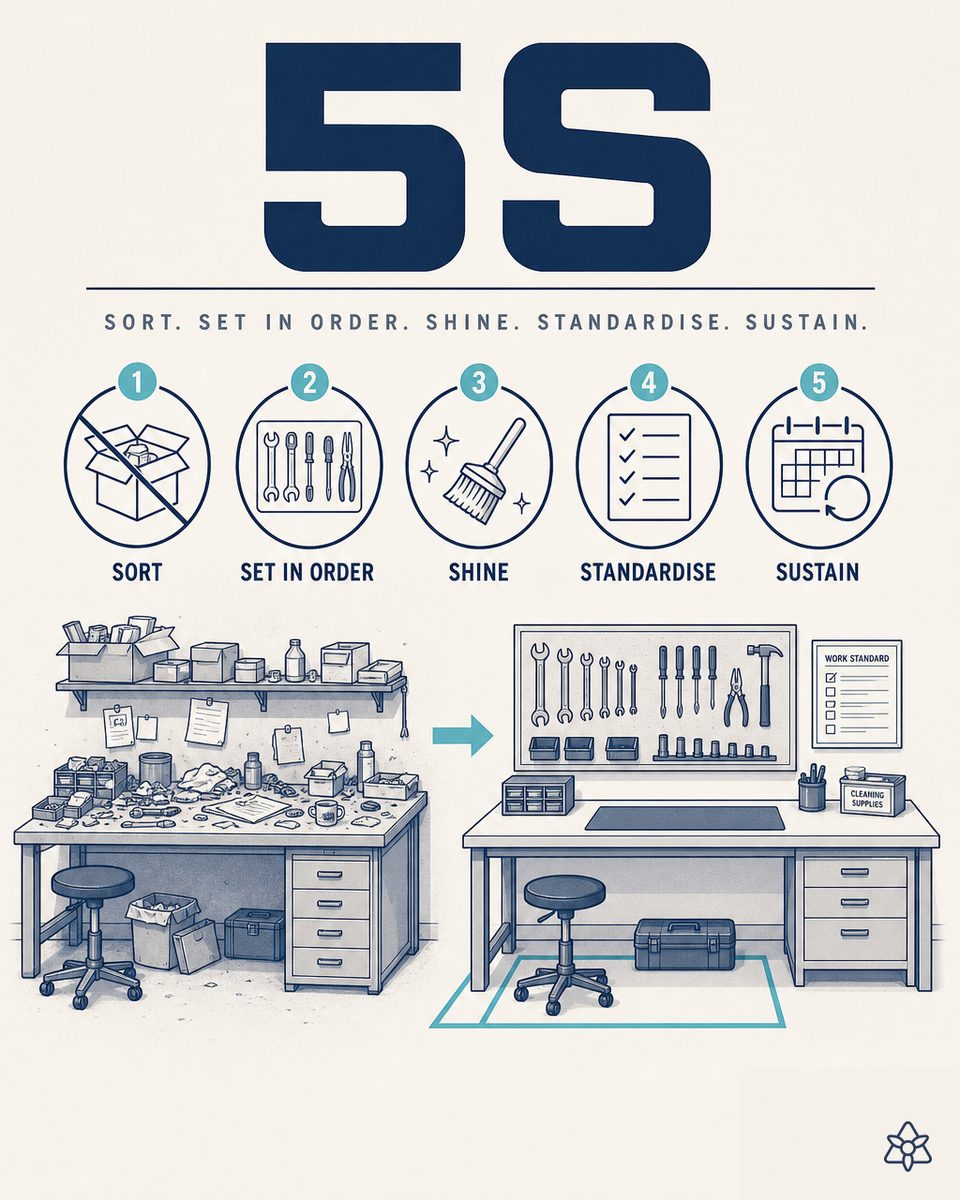
Fill in your 5S audit by hand; an AI agent does the rest
Not rolled out yet? Download our 5S audit template, fill it in by hand and snap a photo. Your company already has its own? Snap it anyway: the agent learns it from the first photo and reads it every time after.
What the agent does: Scores by area and by S, how they move audit after audit, and a check against a photo of the area: it flags what the photo doesn't back up.
The five S, step by step
The 5S are the cultural foundation of Lean Manufacturing. Their order isn't random: each step builds on the previous.
- Seiri (Sort): separate what's needed from what isn't. Anything that doesn't add value is removed from the workstation.
- Seiton (Set in Order): every tool has a single place, marked visually. "A place for everything, and everything in its place."
- Seiso (Shine): daily cleaning that's also inspection — dirt reveals incipient breakdowns.
- Seiketsu (Standardize): document the first three S so they don't depend on the individual.
- Shitsuke (Sustain): sustain the system over time through habit, audit, and continuous improvement.
iLEAN doesn't replace the method — it brings it into the 21st century.
Every Lean methodology was born to solve an information problem: where stock is, which machine is failing, what changed shift-to-shift. When information is paper, methods are rituals. When it's live data, they become the actual engine of the plant.
Classical method tells you what to measure. The IRIS system guarantees the measurement reaches whoever decides, the moment they decide — without anyone typing it in.
The three capture layers applied: Connect (photo, voice, email, WhatsApp), Edge (computer vision on the line) and Integrations (ERP/MES/SCADA/PLC). On top of that unified information, specialized agents serve the exact context to each person on the floor.
Classical 5S vs. digital 5S with iLEAN
| Aspect | Paper 5S | 5S with iLEAN |
|---|---|---|
| Audit | Paper sheet, monthly | Photo + geotag, continuous |
| Deviation evidence | Handwritten note | Automatic timestamped snapshot |
| Visual standard | Photo on board | Digital template comparable with current reality |
| Follow-up | Supervisor's notebook | Live dashboard, drift alarms |
| Corrective action | Post-audit email | Assigned to operator in the moment |
What people ask about digital 5S
What does 5S stand for and where does it come from?
5S are the five Japanese words Seiri, Seiton, Seiso, Seiketsu, Shitsuke — sort, set in order, shine, standardize, and sustain. They originated at Toyota as the visual-order foundation of the plant floor, and they are the first step of Lean Manufacturing in any sector.
How does digital 5S differ from classical 5S?
Classical 5S lives on paper — monthly checklists, photos pinned to boards, handwritten notes. Digital 5S with iLEAN turns every audit into a sequence of geo-tagged photos compared with the visual standard; any drift generates an alarm. The culture stays Lean; what changes is that information no longer depends on paper.
How does iLEAN audit a 5S zone without operators filling out paper?
The operator runs a scheduled route on their phone or tablet and captures photos at the defined points. Computer vision compares each photo with the standard; deviations are logged automatically. The operator just confirms — no forms.
Does 5S work in any plant or only in assembly production?
It works in any organized physical environment: production, warehouse, maintenance shop, quality lab, engineering office. The method adapts — what changes is what's sorted and how it's set in order, not the philosophy.
How long until you see results from rolling out 5S with iLEAN?
The first two S (Seiri and Seiton) show in weeks: the workstation gets organized. Sustain (Shitsuke) takes months to become habit — but iLEAN's automatic alarms accelerate the process by eliminating 5S's main failure mode: forgetting after the initial rollout.
Tell us about your plant. We'll tell you how we'd do it.
25 years applying Lean in real plants. Free diagnostic conversation.
Request demo See Lean Manufacturing