Color changeover on an ink line — cleaning validated before startup, not when the first batch comes out contaminated.
An ink line's circuit has memory: residue from the previous color survives in pumps, hoses and dead zones, and a few grams of black are enough to push a batch of white out of tolerance. Today the cleaning is called good by eyeballing the rinse solvent — with no record of what was actually done. iLEAN Edge guides the wash sequence for each transition, validates the rinse with the camera, and holds the next color's startup until the cleaning passes. The person signs — the line never starts on its own.
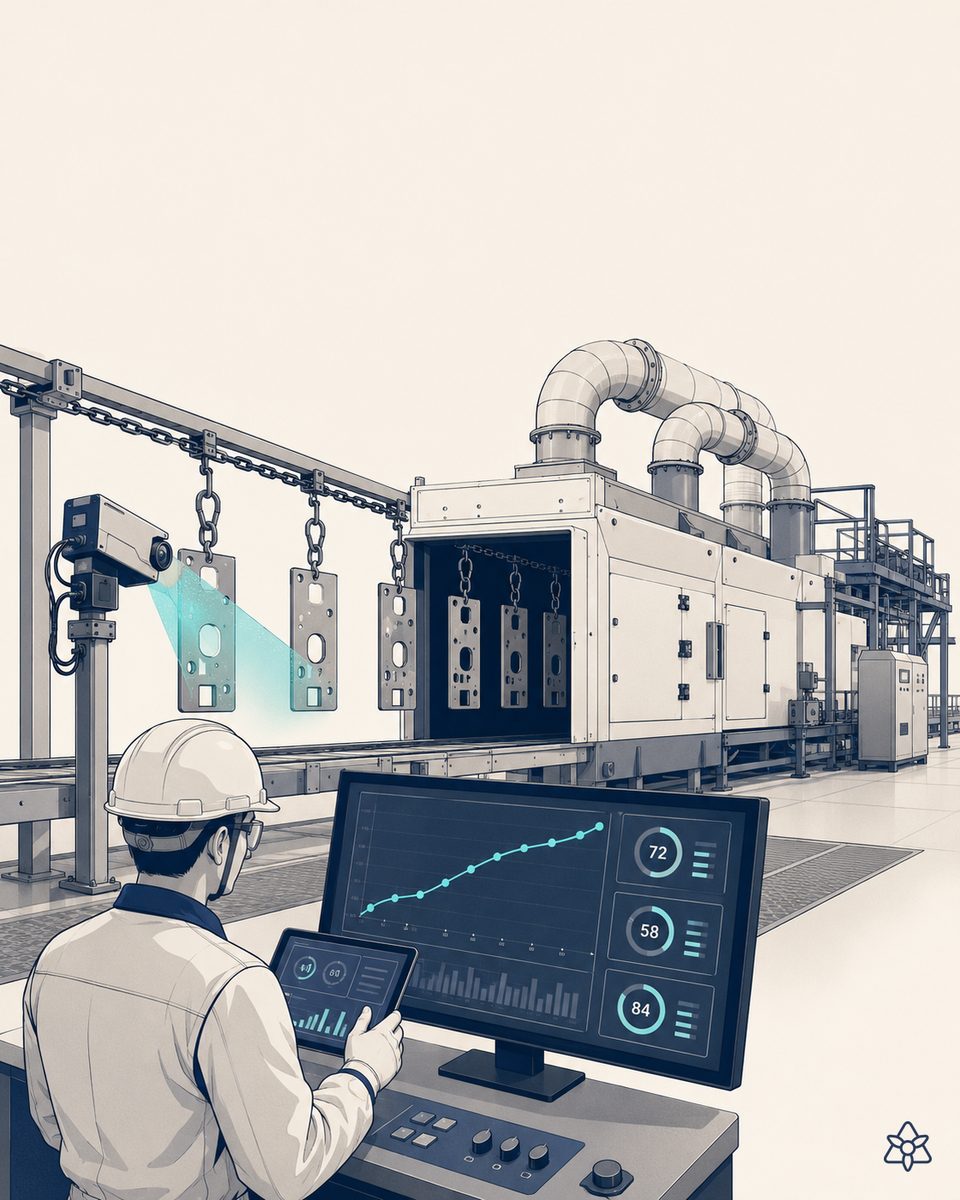
The previous color's residue gives no warning — it shows up in the next color's first batch.
On a multiproduct line for inks, coatings or pigments, the color changeover is the highest quality-risk moment of the week: cross-contamination is not visible while cleaning, it is visible while manufacturing. On the floor:
- The circuit has dead spots — pumps, hoses, gaskets, elbows, tank bottoms, the mill. Residue survives a “correct” cleaning and waits for the next color.
- Validation is by eye — someone looks at the rinse solvent and decides from experience. Black to white forgives almost nothing; light to dark forgives almost everything.
- The wash goes unrecorded — how many cycles, how much solvent, who decided to start: nothing gets written down. When the batch comes out gray, there is no way to know which stage was cut short.
- Production pressure pushes — the changeover is line downtime. The temptation of “good enough” exists on every shift, and without an objective criterion, it often wins.
The quality manager knows it; the line lead knows it. The classic system works 99% of the time. That 1% is the batch of white with a gray cast nobody can explain — and then the whole cleaning gets repeated with the batch already made and lost, and the schedule rebuilt around it.
iLEAN does not change your cleaning procedure — it guides it, validates it and puts it on record.
The changeover does not fail for lack of a procedure; it fails because the procedure lives in the operator's head and the validation has neither an objective criterion nor a record. iLEAN acts as the putty that fills the gap between the cleaning procedure, the line and the scheduling ERP, without forcing you to change anything.
Edge guides the wash sequence and watches the rinse with the camera. The agent holds the startup until the cleaning passes validation. The person signs — the line never starts on its own.
The iLEAN pieces applied to the color changeover:
- Edge — a terminal at the line. It identifies the transition from the production orders (which color you are leaving, which you are entering) and guides the wash sequence that applies — yellow→orange is not black→white — with hands-free voice confirmation of each stage. At the end, the camera evaluates the clarity of the rinse solvent against that transition's standard. It works without a network.
- Connect — if the line has meters or flow sensors, it captures the solvent consumed and the real time per stage; if not, the times come from the voice confirmations. Solvent consumption per changeover stops being an estimate.
- Changeover agent — cross-references transition + executed sequence + rinse result. If a stage is missing or the validation fails, it holds the next order's startup until the rinse is repeated or the quality manager signs off the exception. Every changeover is fully recorded: stages, cycles, solvent, result and signatures.
Cleaning at the shift's discretion vs. changeover validated with iLEAN Edge
| Aspect | Eyeball + experience | With iLEAN Edge (validated, traced changeover) |
|---|---|---|
| Wash sequence | In the operator's head | Guided per transition, confirmed stage by stage |
| Rinse validation | By eye, per shift and hurry | Camera against that transition's standard + signature |
| Changeover record | None, or one line in the log | Stages, times, solvent and operator, automatic |
| Startup on doubtful cleaning | Depends on production pressure | Held until validation or a signed exception |
| Contaminated first batch | Caught in QC, batch already made | Prevented before startup |
| Changeover duration | Estimated after the fact | Measured per stage — real input for SMED |
Impact estimate for your plant — to be validated with your numbers.
The block below is an estimate to be validated with the specific data of your plant. We put it forward so the committee has an order of magnitude; we refine it during the diagnostic.
- Ink, coating or pigment plant with multiproduct lines and frequent color changeovers — especially if it makes whites and light colors, or low-migration inks for food packaging.
- Edge pilot on one line, starting with the most punishing transition (dark→light). First value expected within a few weeks.
- Indicative payback between 4 and 9 months, depending on changeovers/month, the average cost of a contaminated first batch (product, repeated cleaning, delay) and today's changeover time.
- Hard levers: ≥ 40% reduction in first batches out of tolerance from cross-contamination; shorter, more consistent changeovers with duration measured per stage; a per-changeover record ready for audits.
And the quality manager's reasonable doubt
“What if the camera passes a cleaning that is not clean?” — false negatives exist, and that is why the system never decides alone. Hallucination is a problem of free generation, not of anchored tasks. In tasks where the AI merely compares the rinse against the standard defined for that transition, the best models brought error below 1.5% [1]. And even so, what is critical is never decided alone: iLEAN warns and the operator or the quality manager sign. The three safety rings exist precisely for this.
[1] OpenAI paper “Why Language Models Hallucinate”, 2025 — on the reliability of AI in anchored tasks.
What people ask about color changeover cleaning
Why does a color changeover contaminate the first batch of the next color?
Because an ink line's circuit has memory: residue from the previous color survives in pumps, hoses, gaskets, elbows and dead zones of the tank or the mill even when the cleaning “was done”. A few grams of carbon black or phthalo blue in a batch of white or yellow are enough to push it out of tolerance. The critical transitions are always from a strong color to a light one, and between incompatible bases — and not every transition needs the same cleaning.
How is cleaning validated today, and why does it fail?
In most plants, by looking at the rinse solvent: when it runs “clean” to the eye, the line starts. It fails for three reasons: (1) the eye cannot see the residual concentration the spectrophotometer will see in the next batch; (2) the decision depends on the shift and on production pressure — with the line down, “good enough” arrives early; (3) there is no record of how many cycles were run or who made the call, so when the first batch comes out contaminated there is no way to know what went wrong or to improve the procedure.
How does iLEAN validate that the cleaning is sufficient before startup?
iLEAN Edge guides the wash sequence for the specific transition — going from yellow to orange is not the same as going from black to white — with voice confirmation of each stage. At the end, the camera evaluates the clarity of the rinse solvent against the standard defined for that transition, and the operator signs the validation. If the line has meters, iLEAN Connect also captures the solvent consumed and the time per stage. The whole changeover goes on record: stages, cycles, solvent, result and signatures.
What happens if the cleaning does not pass validation?
The agent holds the startup: the next color's production order cannot be started in the system until a new rinse pass clears validation or the quality manager signs off the exception — for example, when the transition runs from light to dark and the real risk is low. The decision is recorded with a name and a reason. The person signs — the line never starts on its own. And if a batch still comes out off-shade, the changeover record shows which stage was skipped or cut short.
What does an ink plant gain from a validated, traced color changeover?
Three levers: (1) fewer contaminated first batches — the avoided cost is not just the ink: it is the repeated cleaning, the delay and the rescheduling; (2) shorter, more consistent changeovers: with the real duration measured per stage, each transition's procedure gets tuned with data — direct input for SMED; (3) a record per changeover that stands up in audits for low-migration inks and food packaging, where cross-contamination control is a customer requirement, not a preference. The improvement ranges are an estimate to be validated with your data.
More cases in other sectors
- Net weight and closure control in drum and jug filling — every container verified before it hits the pallet.How iLEAN verifies net weight and closure on every drum and jug in a specialty chemical filling line:…
- Gravimetric dosing of minor additives — what went in and how much, signed in the moment.How iLEAN captures from the scale which additive was dosed and how much, checks it against the formula…
- Ink color control with a spectrophotometer — ΔE measured and validated batch by batch, not by eye against an aging master.How iLEAN captures the spectrophotometer reading and validates each ink batch's ΔE against its agreed…
- Masterbatch color blending in plastics — batch color matches the master, without relying on the operator's eye.How iLEAN verifies masterbatch identity and actual dosing and measures the ΔE of the first parts against…
- Inline offset ink viscosity control during the press run — solvent corrected before density drifts off.How iLEAN captures Ford cup checks and inline viscometer readings during the press run and flags…
- Pigment dispersion in a bead mill — stop at the right fineness, without over-milling.How iLEAN captures Hegman fineness and bead mill parameters pass by pass, so you stop at spec without…
Tell us your case and in 48h we'll send you the estimated ROI for your ink line.
We work on your plant's real data, not ours. Diagnostic with no commitment.
Request estimated ROI in 48h See specialty chemicals