Edge spots defects on the horn face
A micro-crack, a machining mark or an uneven coating on the horn face marks the customer's part or cracks the horn in production. Visual inspection depends on each inspector's experience and on the end of the shift. What slips through shows up at the customer's plant as a claim. iLEAN Edge places a camera above the final inspection table with a vision model trained on good and defective horns. It infers locally, in milliseconds, without sending images to the cloud.
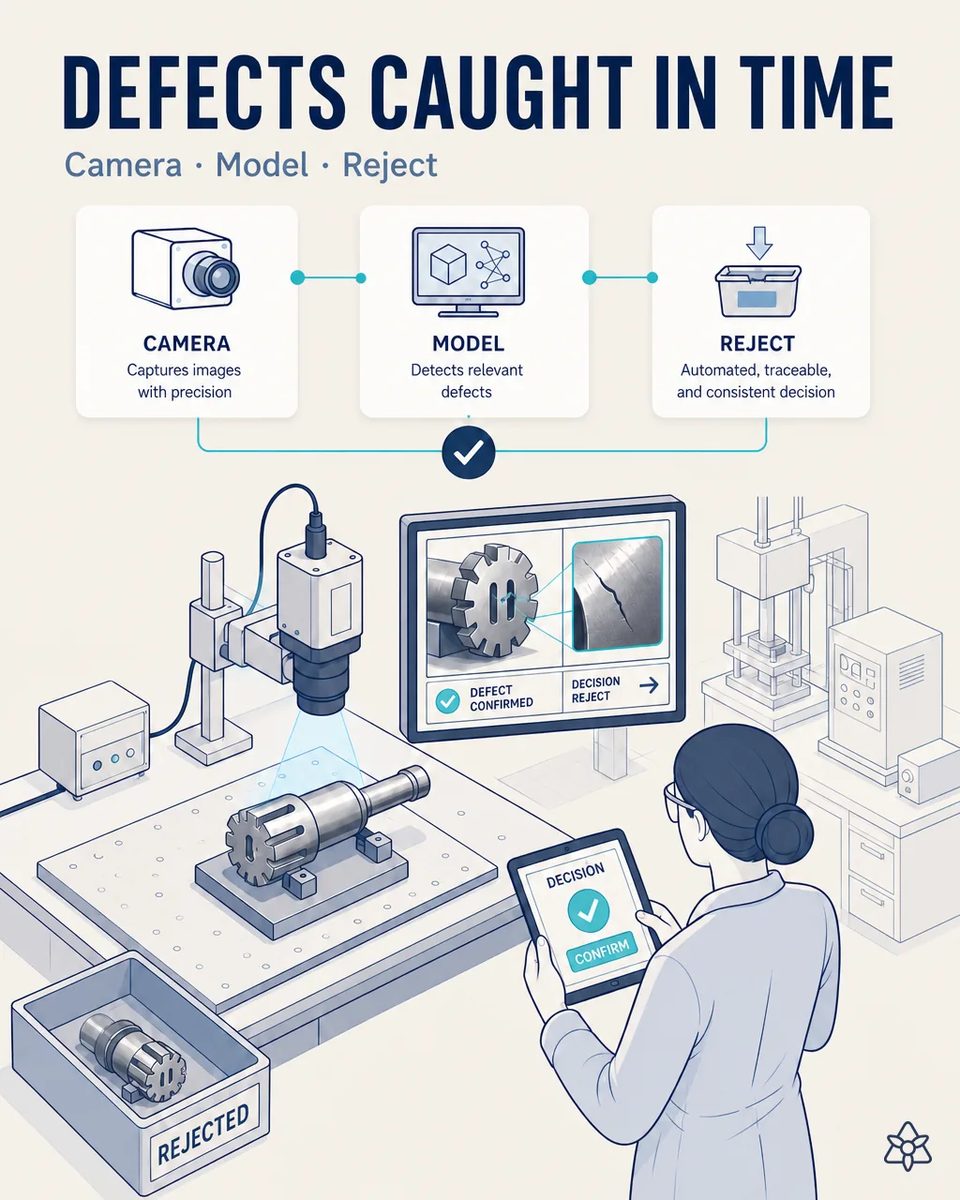
A defect on the horn face shows up at the customer's plant, not on the inspection table.
A micro-crack, a machining mark or an uneven coating on the horn face marks the customer's part or cracks the horn in production. Visual inspection depends on each inspector's experience and on the end of the shift. What slips through shows up at the customer's plant as a claim.
- A micro-crack, a machining mark or an uneven coating on the horn face either marks the customer's part or grows until the horn cracks in production.
- Final inspection is visual and by sampling, and it depends on each inspector's eye and on the hour of the shift. Two inspectors can disagree on the same horn, and neither leaves evidence.
- Slotted horns and multi-contact faces are the hardest: the defect sits in a slot corner or under a coating edge that nobody looks at closely under a lamp. A titanium horn with a hidden crack can pass a tuning test and still fail after weeks of welding.
- What slips through comes back as a claim and a field service trip, often with the customer's line stopped waiting for a replacement horn.
Edge at final inspection — local vision, decision by the inspector.
ILEAN Edge places a camera above the final inspection table with a vision model trained on good and defective horns. It infers locally, in milliseconds, without sending images to the cloud. When it detects a defect, it highlights it and sets the part aside; the inspector confirms or releases it. AI sees; people decide.
The camera does not get tired at the end of the shift and looks at every horn, not a sample. But it does not ship or scrap anything: it highlights what it sees and sets the horn aside, and the inspector confirms or releases. AI sees; people decide. Every horn leaves the table with its image attached to the serial number.
Horn inspection by sampling versus every horn imaged
| Aspect | Today | With iLEAN Edge |
|---|---|---|
| Share of finished horns inspected | A sample per batch | 100% |
| Micro-crack in a slot corner | Depends on the inspector | Highlighted on the image |
| Uneven coating on the face | Seen under a lamp, sometimes | Detected and set aside |
| Evidence per horn | An inspector's initials | Image stored with the serial |
| Horn images leaving the plant | — | None: the model runs on the Edge device |
| Release or reject of a suspect horn | Inspector, by eye | Inspector, with the image in front |
Before: experience-based sampling inspection. After: 100% of horns inspected with evidence.
Impact estimate — to be validated with your numbers.
The block below is an estimate to be validated against your plant's actual data. We put it forward so the committee has an order of magnitude; we refine it during the assessment.
- Estimated payback 5-12 months, depending on how many horns you ship and what a field replacement costs you today.
- From experience-based sampling to 100% control of horns, with an image as evidence for each one.
- Fewer field returns and fewer service trips to replace a cracked horn at the customer's plant, where the cost is the trip plus the customer's stopped line.
- And the inspection image goes into the machine's delivery dossier, which is what an automotive or medical-device customer asks to see.
Payback 5-12 months · 100% horn inspection (estimate to be validated). From experience-based inspection to 100% control of horns, with fewer field returns. Estimated payback of five to twelve months; an estimate to be validated.
And the fair question from the production manager
“What if it flags good horns and blocks shipments?” — the false positive is the real risk of any vision system, which is why the model is trained on good and defective horns of your own designs, under the lighting of your inspection table. Classifying a known defect type on a known geometry is an anchored task where the best models drop below 1.5% error [1], and borderline cases are not scrapped: the inspector decides, and every decision feeds back into training. In the first weeks the thresholds are tuned with your quality team, not left at a factory default.
[1] OpenAI paper "Why Language Models Hallucinate", 2025 — on the reliability of AI in anchored tasks.
What people ask about inspecting the horn face by camera
Which horn defects does it detect?
Micro-cracks, machining and EDM marks, burrs on slots, uneven or damaged coating and damage to the contact face. The defect list is set at commissioning with your quality team, starting with the defects that have caused claims.
Does it work on slotted horns and complex faces?
Yes. The camera setup is designed for your geometries, with several views where a slot or a corner needs it. That is exactly where sampling inspection misses most. Large block horns may need the horn rotated on a simple fixture, which is defined during commissioning.
Do images of our horn designs leave the plant?
No. Inference runs locally on the Edge device in milliseconds. Images stay in your plant and are stored with the horn's serial number, which also protects your horn designs. Nothing leaves the plant unless you decide to export it for a customer dossier.
How many defective horns are needed to train it?
Fewer than expected, because horn defects repeat. What matters is that they are real horns from your designs, collected during the first weeks, including the ones already in your reject bin. The model keeps learning from every confirmed or released horn after go-live.
Does it replace the inspector?
No. It sets suspect horns aside and shows why; the inspector confirms or releases each one. The inspector's time goes to the doubtful cases instead of the routine ones, and their decisions keep training the model.
Tell us how many horns came back from the field last year with a face defect.
We work on your plant's real data, not ours. Assessment with no commitment.
Request estimated ROI within 48h ‹ See all cases of ultrasonic welding equipment See metal fabrication and capital equipment