Edge validates the configuration before closing the machine
Twenty, thirty or forty kilohertz frequency, a booster with its ratio, a custom horn, actuator and generator per order. Configure-to-order multiplies the combinations. Before closing the housing, someone signs that everything is right. A wrong booster or a generator of another frequency is found at the customer's plant. iLEAN Edge compares what the cameras see, components, labels and serial numbers, with the order configuration in the ERP.
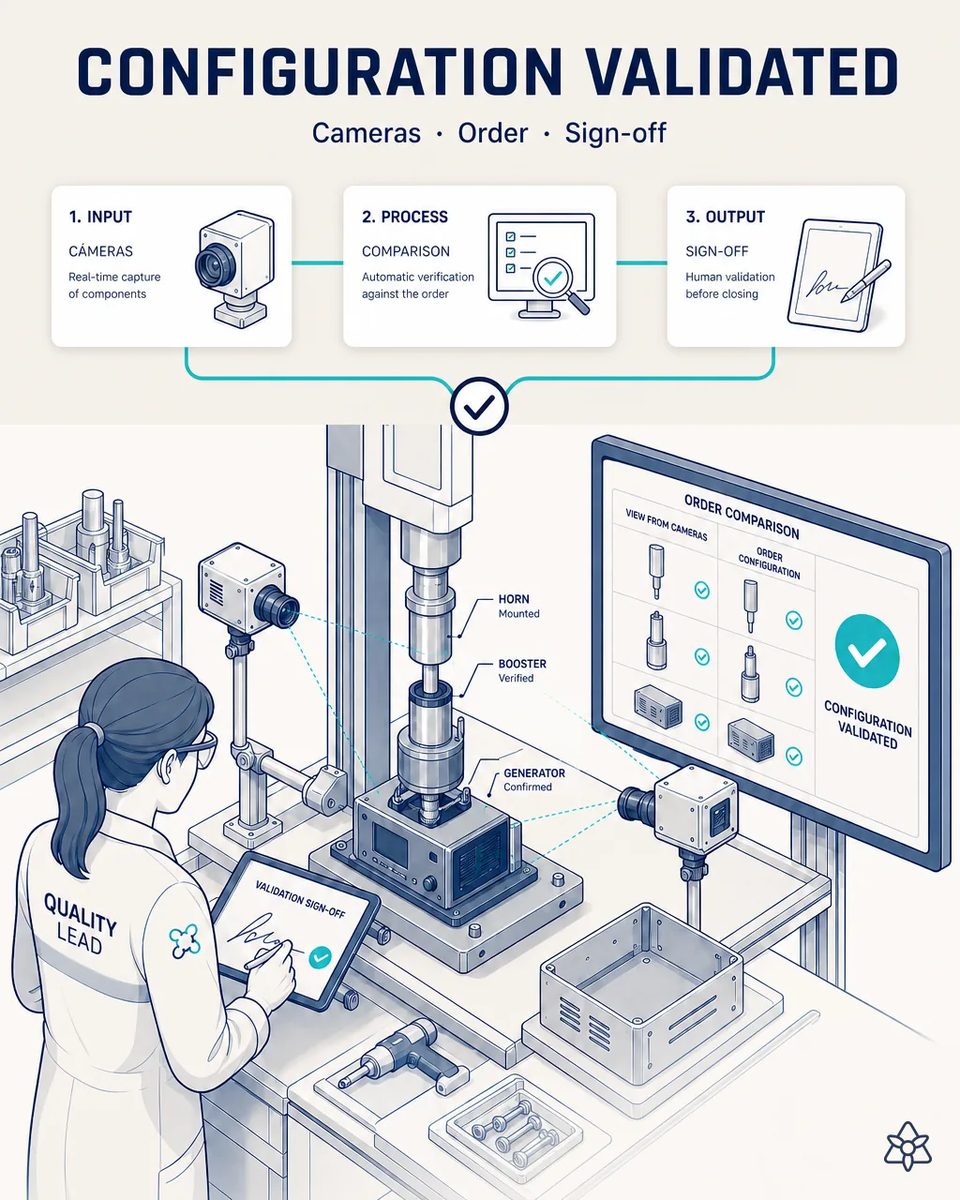
Configure-to-order multiplies the ways to close a machine wrong.
Twenty, thirty or forty kilohertz frequency, a booster with its ratio, a custom horn, actuator and generator per order. Configure-to-order multiplies the combinations. Before closing the housing, someone signs that everything is right. A wrong booster or a generator of another frequency is found at the customer's plant.
- Each order combines a frequency of 20, 30 or 40 kHz, a booster with its ratio, a custom horn, an actuator and a generator. The combinations multiply with every option.
- Many of those components look almost the same: a 1:1.5 booster and a 1:2 booster, or two generators of different frequency in the same housing. Under time pressure, the eye sees what it expects.
- Before closing the housing, someone signs that everything matches the order. The signature is honest, but it is not evidence, and nobody can prove afterwards what was actually mounted.
- A wrong booster or a generator of another frequency is found at the customer's plant, during start-up, with a service technician flying out to swap it and the customer's line launch waiting on the result.
Edge with JIDOKA AI — the machine does not go to packing until the cameras and the order agree.
ILEAN Edge compares what the cameras see, components, labels and serial numbers, with the order configuration in the ERP. If something does not match, iLEAN keeps the machine from moving to packing until the cameras agree and the quality lead signs with the evidence in front of them.
The check happens at the moment that matters, before the housing is closed, when swapping a booster takes minutes. Afterwards it takes a flight. The cameras compare; the quality lead signs with the evidence in front of them, and that evidence stays with the serial number. When a customer asks what was shipped, the answer is an image, not a recollection.
Release signed from memory versus release signed on evidence
| Aspect | Today | With iLEAN Edge |
|---|---|---|
| Booster ratio against the order | Compared by eye with the traveler | Read from label and compared |
| Generator frequency | Assumed from the part number | Matched to the order configuration |
| Horn and actuator for the order | Signed as correct | Imaged and recorded |
| Mismatch found | At the customer's start-up | Before the housing closes |
| Release sign-off | Without evidence | Signed on images at each critical point |
| Machine moves to packing | After the signature | After cameras agree and the signature |
Before: release sign-off without evidence. After: sign-off based on evidence at every critical point.
Impact estimate — to be validated with your numbers.
The block below is an estimate to be validated against your plant's actual data. We put it forward so the committee has an order of magnitude; we refine it during the assessment.
- Estimated payback 4-9 months, depending on the number of options you sell and how many service trips a wrong component caused last year.
- Zero machines shipped with a wrong component, because a mismatch stops the machine before packing.
- Fewer warranty service trips to swap a booster or a generator at the customer's plant, each one a flight, a technician's days and a customer waiting.
- And a release sign-off backed by images at every critical point, which goes straight into the delivery dossier.
Payback 4-9 months · zero machines shipped with the wrong component (estimate to be validated). Zero machines shipped with a wrong component and fewer warranty service trips. Estimated payback of four to nine months; an estimate to be validated.
And the fair question from the production manager
“A booster with the wrong ratio looks identical, how can a camera tell?” — it does not guess from the shape: it reads the label, the engraved part number and the serial, and compares them to the order in the ERP. Reading and matching known identifiers is an anchored task where the best models drop below 1.5% error [1]. When a label is unreadable, the system does not pass the machine silently: it asks the quality lead to check that point. A doubt becomes a human check, never a silent pass.
[1] OpenAI paper "Why Language Models Hallucinate", 2025 — on the reliability of AI in anchored tasks.
What people ask about checking the machine configuration by camera
What exactly is compared against the order?
Horn, booster ratio, transducer, actuator and generator frequency and power, read from labels, engravings and serials. The checkpoints are defined with your engineering team, and they can differ per machine family or per customer.
Does it slow down final assembly?
The comparison takes seconds while the machine is still open. What takes time today is finding a mismatch at the customer's plant. At the station, the quality lead signs on screen instead of walking around the machine with a checklist.
What if the order configuration in the ERP is itself wrong?
The cameras then disagree with the ERP and the quality lead sees both. The discrepancy gets resolved with engineering before shipping, which is also worth knowing because the ERP drives spare parts later. A wrong configuration in the ERP would otherwise send the wrong spare booster years later.
Can the check be skipped for an urgent shipment?
An exception can be signed by the quality lead and is recorded as such. What cannot happen is a machine leaving with no trace of who decided. Exceptions are reviewed weekly, so a habit does not grow from an urgency.
Does it work with highly customized one-off machines?
Yes, because it compares against each order's own configuration, not against a fixed template. The more options you sell, the more it is worth. A new component is added to the catalog with a few reference images.
Tell us how many service trips last year were to swap a wrong component.
We work on your plant's real data, not ours. Assessment with no commitment.
Request estimated ROI within 48h ‹ See all cases of ultrasonic welding equipment See metal fabrication and capital equipment