The tuning bench, stitched to the ERP
The tuning bench and the impedance analyser already have software and data export. But they do not talk to the ERP: resonant frequency, impedance and amplitude are copied by hand into the machine record. Every horn and every transducer is logged twice. One mistyped digit in the frequency ends up as a machine that will not start at the customer's plant. iLEAN Connect reads the bench result as soon as the test ends and writes it via API to the serial-number record, together with the order and the tooling revision.
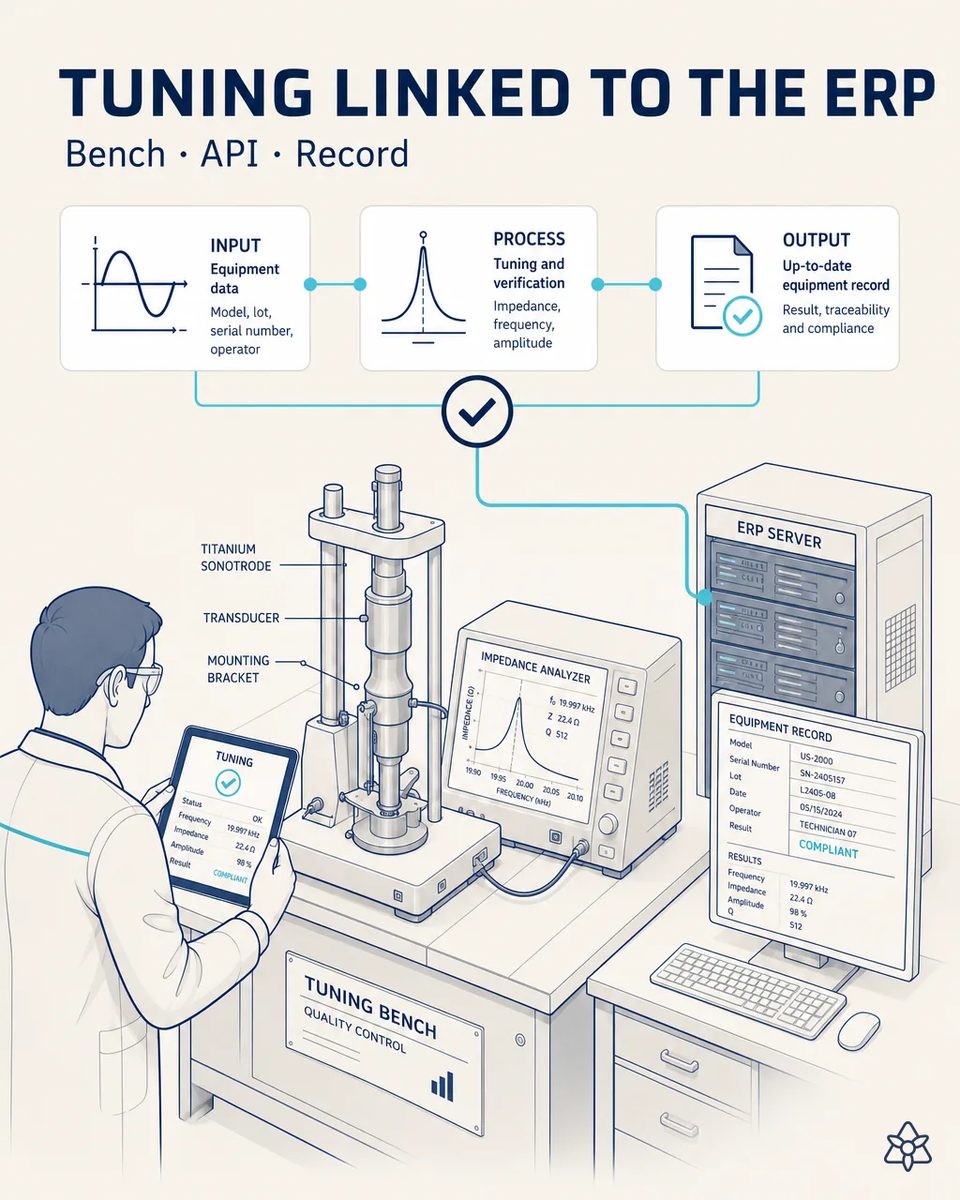
The bench measures the frequency precisely; a person copies it by hand.
The tuning bench and the impedance analyser already have software and data export. But they do not talk to the ERP: resonant frequency, impedance and amplitude are copied by hand into the machine record. Every horn and every transducer is logged twice. One mistyped digit in the frequency ends up as a machine that will not start at the customer's plant.
- The tuning bench and the impedance analyzer already have their own software and data export. What they do not have is a link to the ERP, so their precision stops at the bench's own screen.
- Resonant frequency, impedance and amplitude are copied by hand into the machine record, so every horn and every transducer is logged twice, once on the bench and once in the ERP.
- One mistyped digit, 19.97 instead of 19.997 kHz, travels into the technical record and ends up as a generator set to the wrong window at the customer's plant.
- And when a machine fails to start in the field, service cannot trust the record to know what was really measured on the bench, so the first visit is spent measuring again.
Connect on the tuning bench export — the bench and the ERP stay as they are.
ILEAN Connect reads the bench result as soon as the test ends and writes it via API to the serial-number record, together with the order and the tooling revision. The bench stays the same and so does the ERP. The technician confirms on the tablet and the record is complete.
Nothing on the bench is replaced and nothing in the ERP is customized. iLEAN reads the result the bench already exports, attaches it to the serial number with the order and tooling revision, and the technician confirms on the tablet. The number the generator is set to is the number the bench measured, for every horn and every transducer, without exceptions on busy days.
Frequencies copied by hand versus frequencies read from the bench
| Aspect | Today | With iLEAN Connect |
|---|---|---|
| Resonant frequency in the record | Copied by hand, twice | Written once from the bench |
| Impedance and Q per horn | Often left out | Stored with the serial |
| Tooling revision of the horn | Inferred later | Attached at the test |
| Mistyped frequency digit | Reaches the customer's plant | Not possible by re-keying |
| Serial-number record | Complete days later | Complete when the test ends |
| Bench software and ERP | — | Unchanged |
Before: frequencies copied by hand twice. After: serial-number record complete when the test ends.
Impact estimate — to be validated with your numbers.
The block below is an estimate to be validated against your plant's actual data. We put it forward so the committee has an order of magnitude; we refine it during the assessment.
- Estimated payback 3-6 months, the shortest of the Connect cases in this matrix because the data already exists and only the copying is removed.
- Zero re-keying of frequencies, impedance and amplitude, and the technician's time goes back to tuning instead of typing.
- Zero human-origin errors in the technical record of each serial number, which is the record service, spare parts and the customer's audit all read.
- Fewer failed start-ups in the field, because the generator is set against what the bench really measured, and service arrives knowing the real values. A start-up that works first time is what the customer remembers.
Payback 3-6 months · zero re-keying of frequencies and impedance (estimate to be validated). Zero human-origin errors in the technical record and fewer failed start-ups in the field. Estimated payback of three to six months; an estimate to be validated.
And the fair question from the production manager
“Why AI, if the bench already exports a file?” — because the export rarely lines up with the ERP: different units, columns per firmware version, a serial typed by the operator. Mapping that export to the right serial, order and revision is an anchored task, where the best models drop below 1.5% error [1], and a frequency outside the horn's design window is flagged for the technician instead of written. The bench remains the source of truth; iLEAN only stops it from being retyped.
[1] OpenAI paper "Why Language Models Hallucinate", 2025 — on the reliability of AI in anchored tasks.
What people ask about connecting the tuning bench
Does it work with our impedance analyzer and its export format?
It works with the export the analyzer already produces, whether a CSV, a report or a screen. The format is mapped at commissioning, including different firmware versions. If you have two benches of different brands, both are mapped to the same record.
Which values reach the serial-number record?
Resonant frequency, impedance, amplitude and quality factor, plus the order, the tooling revision and the technician. The full curve can be stored as evidence for the delivery dossier, which medical-device customers in particular ask for.
What if a horn is tuned several times after re-machining?
Each test is kept with its time, and the record shows the final value and the history. That history is useful to engineering when a horn design needs several passes, and it shows how much tuning time each design really consumes.
Does the technician still confirm the result?
Yes, on the tablet, in two taps. The record is written once the technician confirms, not before, and a value outside the design window needs an explicit decision. That decision is recorded, so engineering can review every out-of-window horn later.
Do we need to customize the ERP for this?
No. The write goes via the ERP's API to fields that already exist in the serial-number record, or to an attachment if they do not. Your ERP partner does not need to develop anything for the first version.
Tell us how many horns and transducers go through your tuning bench each week.
We work on your plant's real data, not ours. Assessment with no commitment.
Request estimated ROI within 48h ‹ See all cases of ultrasonic welding equipment See metal fabrication and capital equipment