The assembly traveler, digital the moment it is filled
In a plant that builds ultrasonic welding equipment, every press or custom system moves through the stations with a printed traveler: serial number, configuration, sign-offs per step and handwritten notes. That sheet stays on the machine cart until someone collects it and keys it in at the end of the shift. Meanwhile, planning does not know which station each order is at or what issues it carries. With iLEAN Connect, the technician takes a photo of the sheet when closing the station. iLEAN recognizes the structure, extracts serial, step, sign-off and notes, and stores them in central memory.
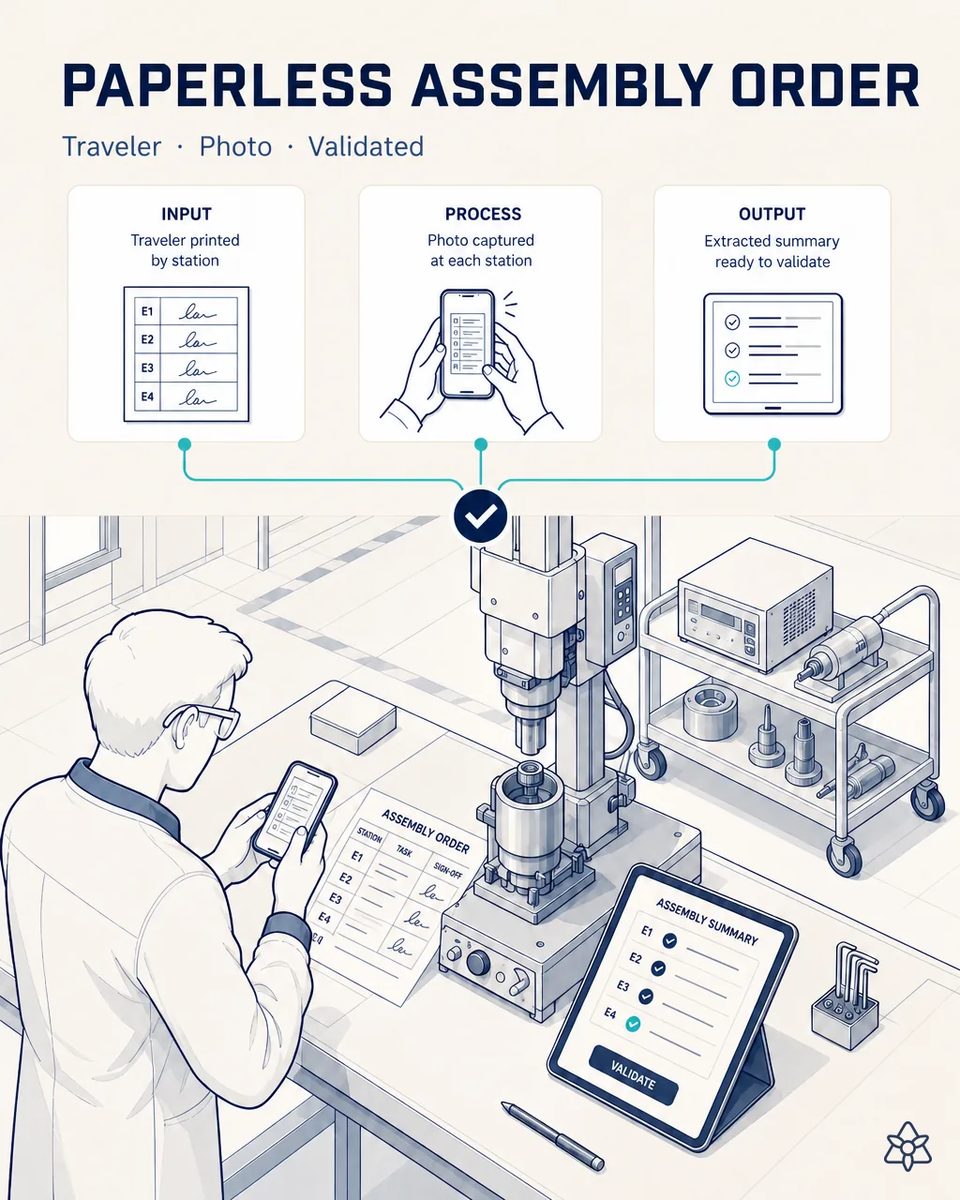
The traveler knows where every machine is; nobody else does until evening.
In a plant that builds ultrasonic welding equipment, every press or custom system moves through the stations with a printed traveler: serial number, configuration, sign-offs per step and handwritten notes. That sheet stays on the machine cart until someone collects it and keys it in at the end of the shift. Meanwhile, planning does not know which station each order is at or what issues it carries.
- Each press or custom system crosses mechanical assembly, actuator fitting, generator wiring, stack mounting and final test with a printed traveler riding on the machine cart.
- That sheet collects the serial number, the configured frequency, the sign-off per step and the handwritten notes: “booster swapped”, “waiting on 30 kHz generator”, “horn back to the shop”. Those notes are the real history of the build.
- It gets keyed in at the end of the shift, so planning works with a picture of the floor that is four to eight hours old, and on Monday morning with one that is two days old.
- When the sales team asks whether the machine for a line launch will make its FAT date, the only honest answer is to walk to the cell and read the cart.
Connect in photo mode — the traveler stays on the cart and the order moves in the system.
With iLEAN Connect, the technician takes a photo of the sheet when closing the station. iLEAN recognizes the structure, extracts serial, step, sign-off and notes, and stores them in central memory. Before anything enters the system, the supervisor sees a summary on the tablet and confirms with two taps. AI captures; people decide.
The technician already signs the step; now they also take a photo of the sheet before pushing the cart to the next station. Nothing else changes, which is why this is usually the first case a build-to-order plant approves, and the one that feeds every later case with the real state of each serial number.
Paper assembly traveler versus traveler captured per station
| Aspect | Today | With iLEAN Connect |
|---|---|---|
| Which station each serial number is at | Known after the shift is keyed in | Updated when the station closes |
| Handwritten notes on the traveler | Lost or summarized late | Extracted and tied to serial and step |
| Re-keying travelers | Someone's last hour of the shift | Disappears |
| Planning a FAT date | With 4-8 h old status | With the floor as it is now |
| Station sign-off | Ink on the traveler only | Ink plus a validated record |
| Assembly technician's routine | — | The same, plus one photo |
Before: order status on paper and 4-8 h latency. After: progress per station in seconds.
Impact estimate — to be validated with your numbers.
The block below is an estimate to be validated against your plant's actual data. We put it forward so the committee has an order of magnitude; we refine it during the assessment.
- Estimated payback 4-9 months, depending on order volume and how many machines are in assembly at once.
- From 4-8 hours of latency down to seconds: progress per station is known when the station closes, not when the shift ends.
- Re-keying of travelers disappears, and with it the transcription errors in serial numbers and configurations that later surface in service and spare parts.
- Planning can commit FAT and shipping dates with the real state of each build instead of yesterday's, and sales stops promising dates the floor cannot see.
Payback 4-9 months · from 4-8 h latency to seconds (estimate to be validated). From four to eight hours of latency down to seconds, and re-keying disappears. Estimated payback of four to nine months depending on order volume; an estimate to be validated with your data.
And the fair question from the production manager
“Can it read our technicians' handwriting on a greasy traveler?” — reading a document whose structure is known, with fixed fields for serial, step and sign-off, is an anchored task, where the best models drop below 1.5% error [1]. A field read with low confidence is flagged instead of guessed, and the supervisor sees the summary on the tablet and confirms with two taps before anything crosses into the system. The photo is kept, so the original sheet can always be checked.
[1] OpenAI paper "Why Language Models Hallucinate", 2025 — on the reliability of AI in anchored tasks.
What people ask about the photographed assembly traveler
Do we have to redesign our assembly traveler?
No. iLEAN learns the structure of the sheet you already print from the ERP, including the columns for station, task and sign-off. If you change the template later, it is retrained on a few examples. Different travelers for presses, generators and full automation cells are learned side by side.
What happens to the handwritten notes like waiting on a booster?
They are the most valuable part of the sheet. They are extracted as free text tied to the serial number and the step, so a pending booster or a horn sent back to the shop shows up in planning the same hour instead of the next morning. The original photo stays attached, so anyone can check what was really written.
Does it work when one machine has several travelers, for the press and the generator?
Yes. Each sheet is linked by serial number and order, so the press, the generator and the stack of the same machine are seen as one build. Planning sees which of the three is holding the machine back, which on a configure-to-order build is usually the generator or the horn.
Do we need ERP integration before starting?
No. The case starts against iLEAN's central memory and the push to the ERP is connected later, once the floor has seen the value. That keeps the first weeks free of IT dependencies.
Who confirms the extracted data?
The assembly supervisor, on the station tablet, in two taps. Nothing written by the AI reaches the order without a person having looked at it, and every confirmation keeps its name and time.
Tell us how many custom machines you have in assembly right now.
We work on your plant's real data, not ours. Assessment with no commitment.
Request estimated ROI within 48h ‹ See all cases of ultrasonic welding equipment See metal fabrication and capital equipment