The applications-lab spreadsheet, straight into the ERP
The applications lab tests each customer's parts and logs amplitude, pressure, energy and pull-test result in a spreadsheet on a shared folder. That spreadsheet defines the welding recipe that will ship. Someone re-keys the data into the ERP or the quality module weeks late, spending hours a month and adding errors to the machine's technical file. iLEAN Connect reads the file every time it is saved, interprets the new rows with an anchored model and, once the lab lead validates, pushes them into the ERP via API.
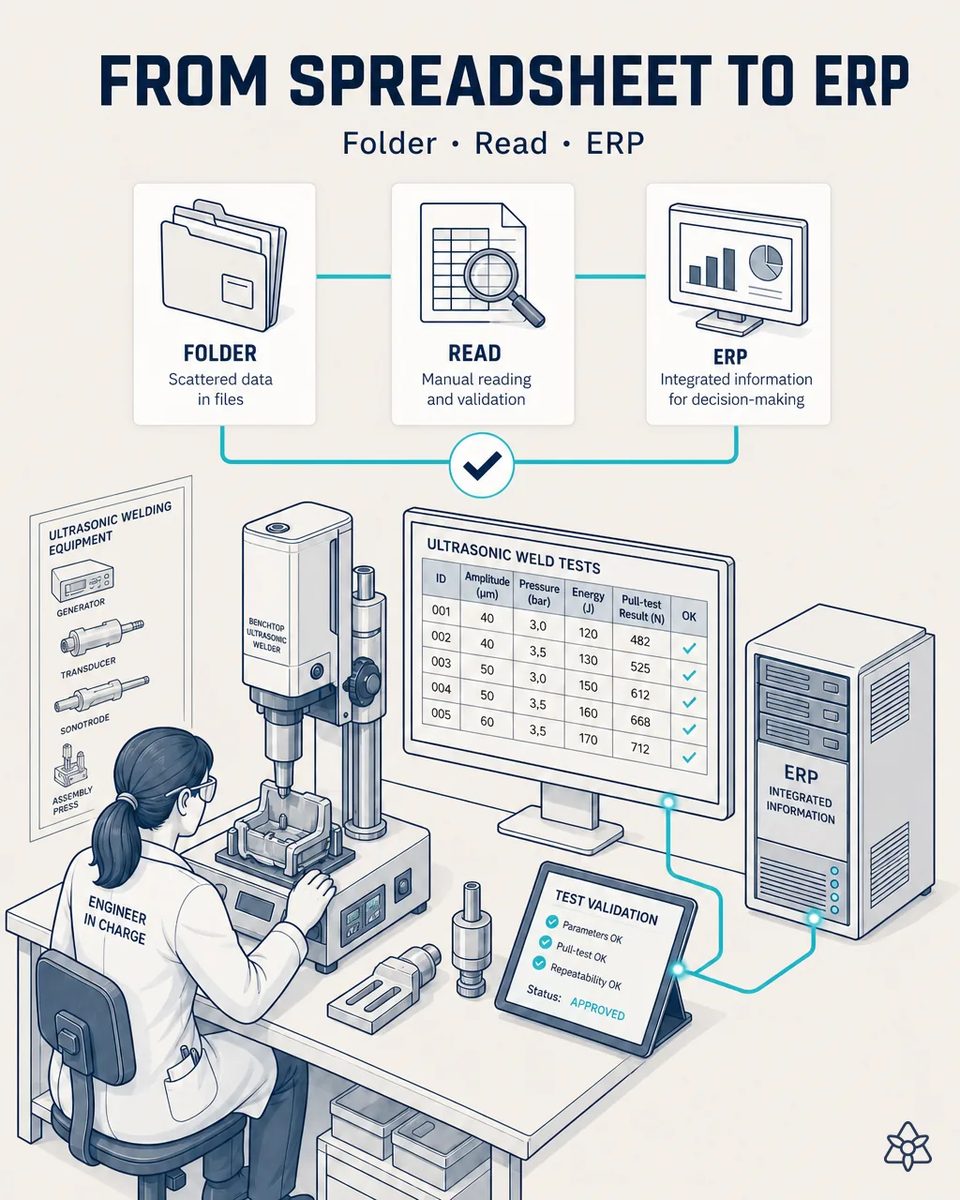
The recipe that will ship with the machine lives in a spreadsheet on a shared drive.
The applications lab tests each customer's parts and logs amplitude, pressure, energy and pull-test result in a spreadsheet on a shared folder. That spreadsheet defines the welding recipe that will ship. Someone re-keys the data into the ERP or the quality module weeks late, spending hours a month and adding errors to the machine's technical file.
- The applications lab tests each customer's parts on a benchtop welder and logs amplitude, trigger force, pressure, energy and pull-test result row by row in a spreadsheet.
- That spreadsheet is what defines the welding recipe that will ship loaded on the machine and be repeated at the customer's FAT.
- Someone re-keys the validated rows into the ERP or the quality module weeks later, spending hours a month and introducing errors into the machine's technical file.
- And to do it, several people keep an ERP quality license open just to load test data they did not generate, while the engineer who ran the trial has already moved to the next customer.
Connect on the lab spreadsheet — the file stays, the re-keying goes.
ILEAN Connect reads the file every time it is saved, interprets the new rows with an anchored model and, once the lab lead validates, pushes them into the ERP via API. If five people log into the ERP today just to load test data, that is five licenses. With Connect only the validator needs one: a typical fifty to eighty percent cut in quality-module licenses, recurring annual savings depending on the vendor's pricing.
The lab keeps its spreadsheet, because that is where engineers think. What disappears is the second life of the data: the weeks of lag and the hours someone spends copying amplitudes and pull-test values into the ERP. The recipe on the machine at FAT is the one the lab signed, with no transcription step in between where a decimal can move.
The lab spreadsheet re-keyed versus the lab spreadsheet read
| Aspect | Today | With iLEAN Connect |
|---|---|---|
| Validated welding recipe in the ERP | Weeks after the trial | Seconds after validation |
| Amplitude, energy and pull-test rows | Re-keyed by hand | Read when the file is saved |
| Errors in the machine's technical file | Typos in amplitudes and energies | Zero re-keying |
| Who validates a recipe | Implicit | The lab lead, named |
| Quality-module licenses for data entry | One per person loading | Only the validator's |
| How the lab works | — | Same spreadsheet, same folder |
Before: weeks of lag and hours of re-keying. After: recipe in the ERP in seconds; -50 to -80% quality-module licenses.
Impact estimate — to be validated with your numbers.
The block below is an estimate to be validated against your plant's actual data. We put it forward so the committee has an order of magnitude; we refine it during the assessment.
- Estimated payback 4-9 months, plus recurring license savings that repeat every year the license contract is renewed.
- A typical 50 to 80% cut in ERP quality-module licenses: if five people log in today only to load test data, with Connect only the validator needs one. The saving depends on your vendor's pricing.
- From weeks of lag to seconds, with zero re-keying of amplitudes, energies and pull-test results.
- The recipe that ships with the machine is the one the lab validated, which is what the customer checks at FAT.
Payback 4-9 months · ERP quality-module licenses -50 to -80% (estimate to be validated). From weeks of lag to seconds and zero re-keying. Estimated payback of four to nine months plus recurring license savings; an estimate to be validated.
And the fair question from the production manager
“Our lab spreadsheets are a mess, every engineer has their own layout.” — that is why the model is anchored to your columns: once it learns which column is amplitude, which is energy and which is the pull-test value, interpreting new rows is an anchored task where the best models drop below 1.5% error [1]. A row that does not fit the expected ranges is flagged, and nothing reaches the ERP until the lab lead validates it.
[1] OpenAI paper "Why Language Models Hallucinate", 2025 — on the reliability of AI in anchored tasks.
What people ask about the applications lab spreadsheet
Do the applications engineers have to change their spreadsheet?
No. iLEAN learns the layout you use, including several templates if each engineer has their own. A new template is learned from a few saved files. The engineers keep their formulas, colors and comments; iLEAN only reads the rows.
Does it pick up every save or only final results?
It reads the file every time it is saved and detects the new rows. Trials marked as discarded can be ignored, and only the rows the lab lead validates are pushed. Exploratory trials stay in the lab's history without polluting the machine's technical file.
How are the quality-module licenses reduced?
Today several people log into the ERP just to load trial data. With Connect only the lab lead who validates needs access, and the push is done via API. The exact saving depends on how your vendor prices those seats. The engineers who only loaded data keep read access where they need it.
Can a recipe be traced back to its lab trial?
Yes. Each recipe in the ERP keeps the link to the trial rows, the file and the person who validated them, which is what a customer asks for at FAT. When a recipe is later adjusted at the customer's plant, the change is recorded against the original trial.
What if the ERP has no API for the quality module?
It is checked during the AI Discovery. Most current ERPs expose one, and where they do not, the data stays in iLEAN's memory until the connection is solved, still validated and still traceable.
Tell us how long a validated welding recipe takes to reach your ERP.
We work on your plant's real data, not ours. Assessment with no commitment.
Request estimated ROI within 48h ‹ See all cases of ultrasonic welding equipment See metal fabrication and capital equipment