Line clearance stops being a signature with no evidence
Changeover is the most dangerous moment of the day in contract manufacturing. You have to empty, clean, strip components, remove leftover printed material and confirm not a single bottle, cap or label of the previous item remains. That clearance takes one to three hours and today it ends when somebody signs a checklist, with no evidence beyond their word.
The chemical risk gets the attention. The physical one causes the mix-up.
The risk has two faces. The chemical one: traces of bulk from one formula in the next, with fragrances, preservatives or actives that in cosmetics are declarable allergens. And the physical one: a handful of the previous brand's caps left in the chute, a roll of labels not properly removed, spare cartons on the table. This second face is what produces the brand mix-up and is, paradoxically, the one with the least control: it is checked by looking, in a hurry, at the end of a long changeover. On top of that sits the cost of the changeover itself: the rechecks and waiting that pile up when it is unclear whether a point is genuinely clear.
- The chemical face: traces of the previous formula, with fragrances, preservatives or actives that in cosmetics are declarable allergens.
- The physical face: a handful of the previous brand's caps left in the chute, a roll of labels not properly removed, spare cartons on the table.
- The second one is what produces the brand mix-up, and paradoxically it is the least controlled: it is checked by looking, in a hurry, at the end of a long changeover.
- And the changeover itself costs: the rechecks and the waiting pile up whenever nobody is quite sure whether a point is genuinely clear.
Edge plus JIDOKA AI — the line stays locked while any point is red.
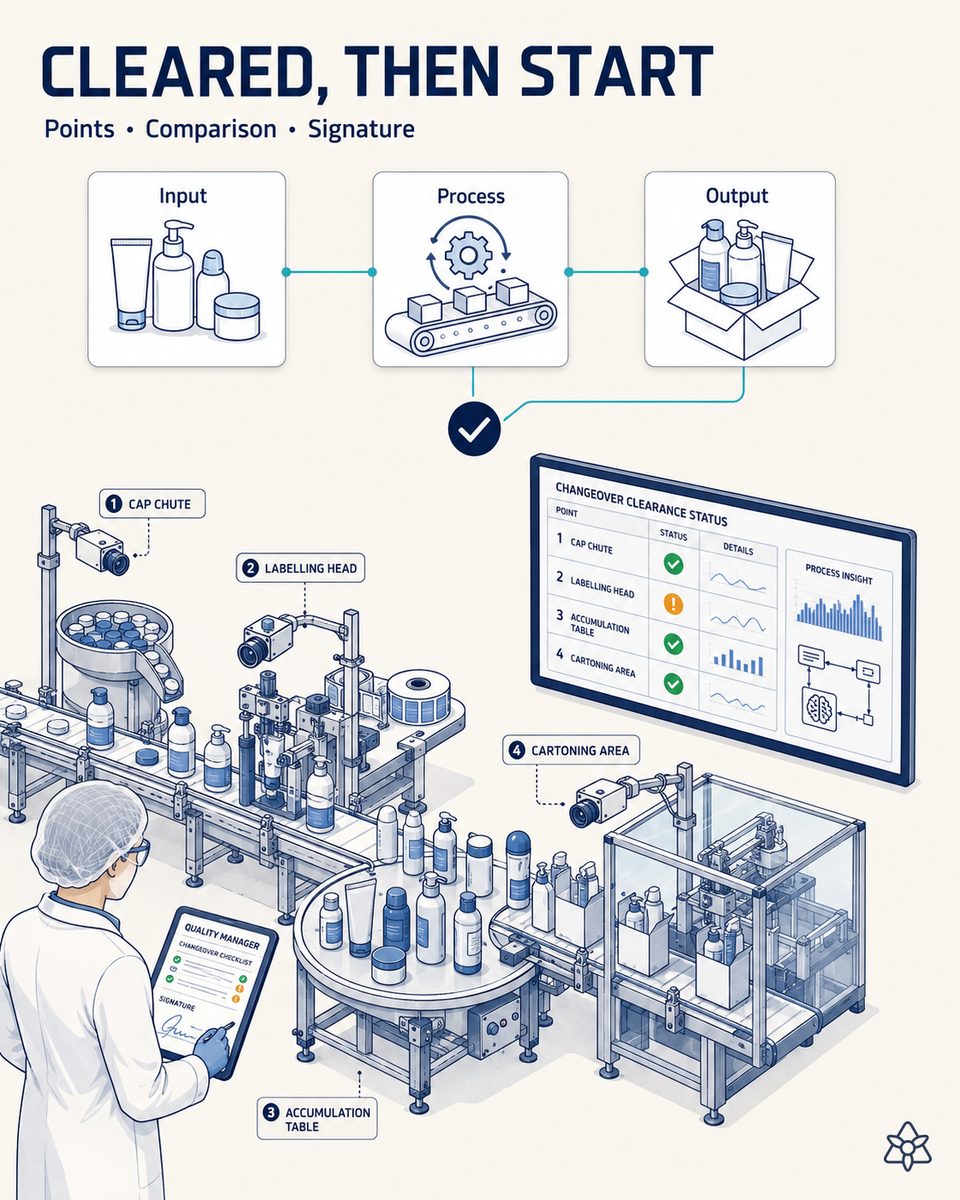
Edge cameras at the critical points quality defines (hopper, filling nozzles, cap chute, labelling head, accumulation table, cartoning area). iLEAN compares each point's current state against its reference state — cleared and set up for the new item — and shows on screen, point by point, what is right and what is not, with the image alongside. While any point is red, the line stays locked: JIDOKA AI. When all are green, the quality manager signs — the AI does not release on its own — and every check is archived with its photo.
The AI does not release the line. It presents each point with its image next to its cleared reference state, and the quality manager signs on evidence instead of on a glance.
A signature with no evidence vs. a verified clearance
| Aspect | Today | With Edge and JIDOKA AI |
|---|---|---|
| State of each point | Checked by eye, against the clock | Compared with its reference state |
| Points verified | The ones there is time for | Hopper, nozzles, cap chute, labeler, table, cartoner |
| Start-up | When somebody signs | Locked until every point is green |
| Backing for the signature | The checklist itself | One archived image per point |
| Leftover printed material | Found in the next batch | Detected before start-up |
| Clearance time | 1-3 h with rechecks | Guided point by point |
from a signature with no evidence to N points verified with images · from a 1-3 h clearance with rechecks to a changeover guided point by point · from mix-up risk depending on human attention to a physical start-up block.
Impact estimate — to validate against your numbers.
The block below is an estimate to be validated against your plant's actual data. We put it forward so the committee has an order of magnitude; we refine it during the assessment.
- Lines changing brand several times a day in a hall shared by a dozen accounts.
- Indicative payback between 4 and 9 months.
- At least 20% off the changeover by removing rechecks and waiting — SMED AI.
- Plus a sharp drop in cross-contamination and leftover-material incidents, which is the expensive tail.
estimated payback of 4 to 9 months. Changeover time down by at least 20% through removing rechecks and waiting (SMED AI), and a sharp reduction in cross-contamination and leftover-material incidents. *Estimate to validate.*
And the fair question from the production manager
“Won't locking the line cost me more than it saves?” — it is the fair objection, and it is why this case travels with SMED AI: the target is a changeover that is faster and verified. The line already waits today, only it waits for a person to walk over. With the points green, the signature happens the moment the state allows it rather than the moment somebody is free.
[1] OpenAI paper "Why Language Models Hallucinate", 2025 — on the reliability of AI in anchored tasks.
What people ask about verified line clearance
Does it replace the cleaning protocol?
No: it verifies that it was carried out. The protocol, the products and the contact times stay yours and stay whatever your cosmetic GMP certification requires. What changes is that the final check stops depending on a hurried look and gets documented point by point.
How many points does it cover?
The critical ones on that line, defined with quality before deployment: hopper, filling nozzles, cap chute, labeling head, accumulation table and cartoning area are the usual six. They are the same ones looked at today — the difference is that the look now leaves an image.
What if a camera fails?
The rule is agreed in advance. The usual setup raises an alert and allows a supervisor override with a record, rather than halting the plant. What is never allowed is an override with no trace: somebody starting up without a green light is precisely the fact worth having on file.
Can it really tell a cleared point from a dirty one?
It is trained on that specific point of that specific line, which is what makes it feasible. Recognizing “this cap chute is empty and clean” is a bounded problem; “detect any dirt anywhere” would not be, and anyone promising the second is overselling.
Does the evidence serve for the brand owner's audit?
That is one of its main uses. Each clearance is filed with its images and its signature, indexed by batch. When a customer asks what guarantees their product was not made straight after another brand's without a proper clearance, the answer becomes a file rather than a conversation.
More cases from this series
- A dozen customers auditing and not one week lostEvery batch dossier builds itself while production runs, indexed by standard and separated by brand. The…
- The failure that ruins the year is not scrapFour coordinated verification rings — intake, changeover, start-up and output — against the error that…
- The batch record exists at second zero, not eight hours laterThree photos at start-up and the batch record exists at second zero, with the real lot of every raw…
- In contract manufacturing, the customer decides the changeiLEAN reads the brand owner's email, extracts the artwork or component change and cross-checks it…
- The most expensive error in this sector starts at an industrial keyboardBatch, expiry and period-after-opening flow from the ERP to the coder using each brand's template. Zero…
- The truck does not wait and the lot is properly tracedPhoto the delivery note and the lot labels: iLEAN extracts, links the certificate of analysis and posts…
Tell us what evidence you have today that the line was actually cleared.
We work on your plant's real data, not ours. Assessment with no commitment.
Request estimated ROI within 48h ‹ See all cases of personal care See cosmetics