The harness traveler sheet, digitised at second zero
In a wire harness plant, every assembly board starts with paper. The traveler sheet states the part number being built, the drawing revision, the board and the critical components going in. The leader's shift log records by hand who worked each station, which reel was loaded, and what stopped and why. Those two documents are the plant's real traceability. And both of them sit for hours, sometimes a whole shift, in a folder in the office before anyone keys them in. The central system knows nothing until the end of the day.
Paper is not the problem. The hours it takes to reach the system are.
Those two documents are the plant's real traceability. And both of them sit for hours, sometimes a whole shift, in a folder in the office before anyone keys them in. The central system knows nothing until the end of the day. The cost does not show up that day. It shows up when there is an escaped defect and you have to answer which reel, which terminal lot, which applicator and which shift. Because the answer lives in paper nobody transcribed, containment gets bounded by a safety range: you contain too much because you cannot contain precisely.
- The traveler sheet says which part number is being built, to which drawing revision, on which board and with which critical components. The shift log records manning, the reel loaded and every stoppage. Those two papers are the plant's real traceability.
- Both sit for hours — sometimes the whole shift — in a folder in the office before somebody keys them in. The central system knows nothing until the end.
- The cost does not show up that day. It shows up when there is an escape and the customer asks which reel, which terminal lot, which applicator and which shift.
- Because the answer lives in untranscribed paper, containment is bounded by a safety margin: you contain too much because you cannot contain precisely.
Connect in photo mode — the leader keeps filling in exactly the same sheet.
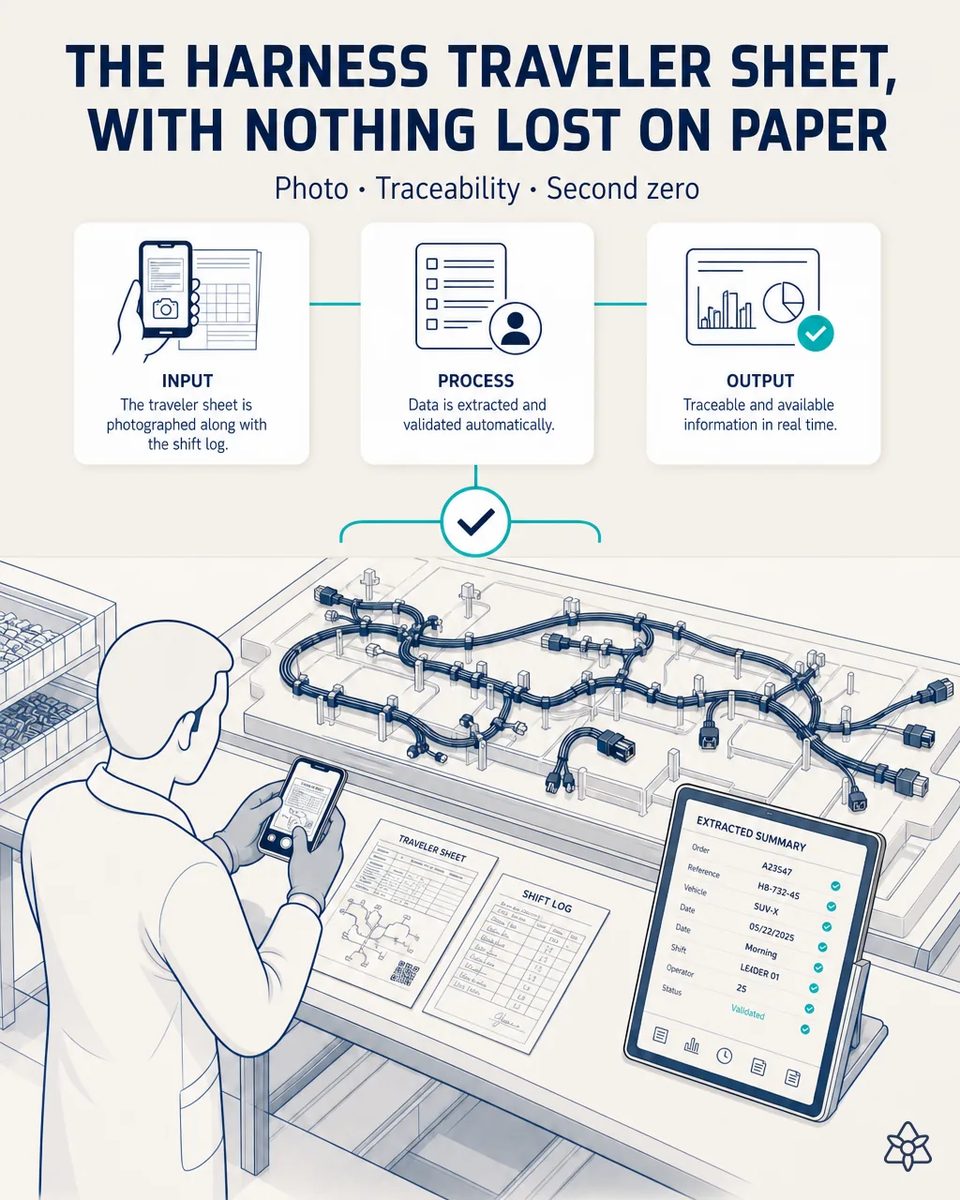
With iLEAN Connect, the leader takes one photo at start-up and one at shift close. A grounded model extracts the structured fields, part number, revision, board, reel, terminal lot, staffing, downtime and incidents, and stores them in central memory tied to the harness and the shift. The paper still exists and the operator still writes by hand: zero habit change. The before and after is easy to tell. From four to eight hours of latency between the fact and the system, or a full shift, down to second zero. And from containment bounded by caution to containment bounded by real traceability.
The habit change is zero, and that is not a detail: it is why the case is still alive in month six, which is where the ones that ask a line leader to learn an app die.
The traveler sheet on paper vs. the traveler sheet captured
| Aspect | On paper today | With iLEAN Connect |
|---|---|---|
| When the harness exists in the system | 4-8 h later, or at shift close | Second zero |
| Reel and terminal lot | Rebuilt from paper, if legible | Tied to the harness from start-up |
| Scope of a containment | By safety margin | By real traceability |
| Answering a customer claim | Hunting through office folders | A query by part number or shift |
| An illegible or mislaid sheet | The harness data is lost | The photo remains as evidence |
| Operator habit | — | Unchanged: still writing by hand |
see the impact section; the attached pool details the before and after for this case.
Impact estimate — to validate against your numbers.
The block below is an estimate to be validated against your plant's actual data. We put it forward so the committee has an order of magnitude; we refine it during the assessment.
- Estimated payback 4-9 months, depending on active boards and how often containment events happen.
- From 4-8 h of latency between the data and the system, to second zero.
- Direct recovery of the support team's transcription time.
- Containment bounded by traceability instead of by caution — the big saving sits here, and it shows up the day there is an escape.
Estimated payback 4-9 months · from 4-8 h of latency to second zero Estimated payback runs between four and nine months depending on how many boards are active and how often containment events happen, recovering directly the transcription time of the production support team. This is an estimate to validate against your own numbers.
And the fair question from the production manager
"What if it misreads a part number and a wrong figure gets in?" — reading fields off a form with a known structure is an anchored task, where the best models drop below 1.5% error [1]. But the real answer is the other one: the extracted summary goes to the tablet and somebody confirms or corrects it before it crosses into the system. Nothing enters on its own.
[1] OpenAI paper "Why Language Models Hallucinate", 2025 — on the reliability of AI in anchored tasks.
What people ask about digitising the traveler sheet
Does the traveler sheet have to change?
No, and that is the condition. The sheet is tuned to how that plant works, and every attempt to replace it with a form on a screen ends with the leader writing on paper anyway and keying it in later. Vision reads the structure of the document as it is.
Does it work with handwriting from several shifts?
Yes, because the model is not asked to guess: it is asked to fill fields on a form it already knows. When a field comes back with low confidence it is flagged on the tablet for a person to confirm, instead of slipping through.
What about the last two years of sheets, which are on paper?
They can be digitised in bulk, but that is not where you start. The value is in the harness being built today; the backlog comes later, once the daily flow is running.
Do we need wifi across the whole bay?
Not for this. The photo is taken on a phone or tablet and syncs when there is coverage. What cannot wait for the network is process control, and that lives in Edge, with local inference.
How long before it runs in one bay?
The AI Discovery is two weeks on a single assembly bay. That defines which fields are captured, what they are validated against and which interface the central system uses; the rollout of that bay follows and is short, because no machine is touched.
More cases from this series
- The audit evidence pack assembles itselfEvery critical event leaves evidence indexed by clause and by customer requirement. The audit stops…
- Zero customer line stop: four coordinated ringsFour cross-checked verification rings from reel to sequenced shipment, holding harness quality steady…
- The crimp lab spreadsheet reaches the ERP on its ownCrimp height, pull test and micrograph data reach the ERP with no transcription, and the quality module…
- The legacy crimp press panel starts talkingAn external camera digitises crimp height, counters and alarms from a legacy cut-and-crimp panel without…
- The supervisor who walks the floor and talks to the systemEarpiece and voice so the harness supervisor records and queries without stopping between boards. Weak…
- Nothing enters the system without a human signing itNothing the AI captures enters the system until a human signs it with two taps at the board. Humans in…
Tell us how many hours pass today between closing a board and the data reaching the system.
We work on your plant's real data, not ours. Assessment with no commitment.
Request estimated ROI within 48h ‹ See all cases of automotive wire harnesses See automotive