Headlight laser marker stitched to the ERP: zero typing, zero serial-error recalls
The laser marker that engraves the DataMatrix on every headlight is relatively modern and has an API — but it's isolated from the ERP, and manual typing remains the standard method. A single fat-finger error can turn into half a shift's production with a wrong serial: resident-engineer escalation and, in the worst case, a recall costing millions. With iLEAN the ERP publishes serial, program version and traceability fields via API straight to the marker. Program change = one tap in the ERP.
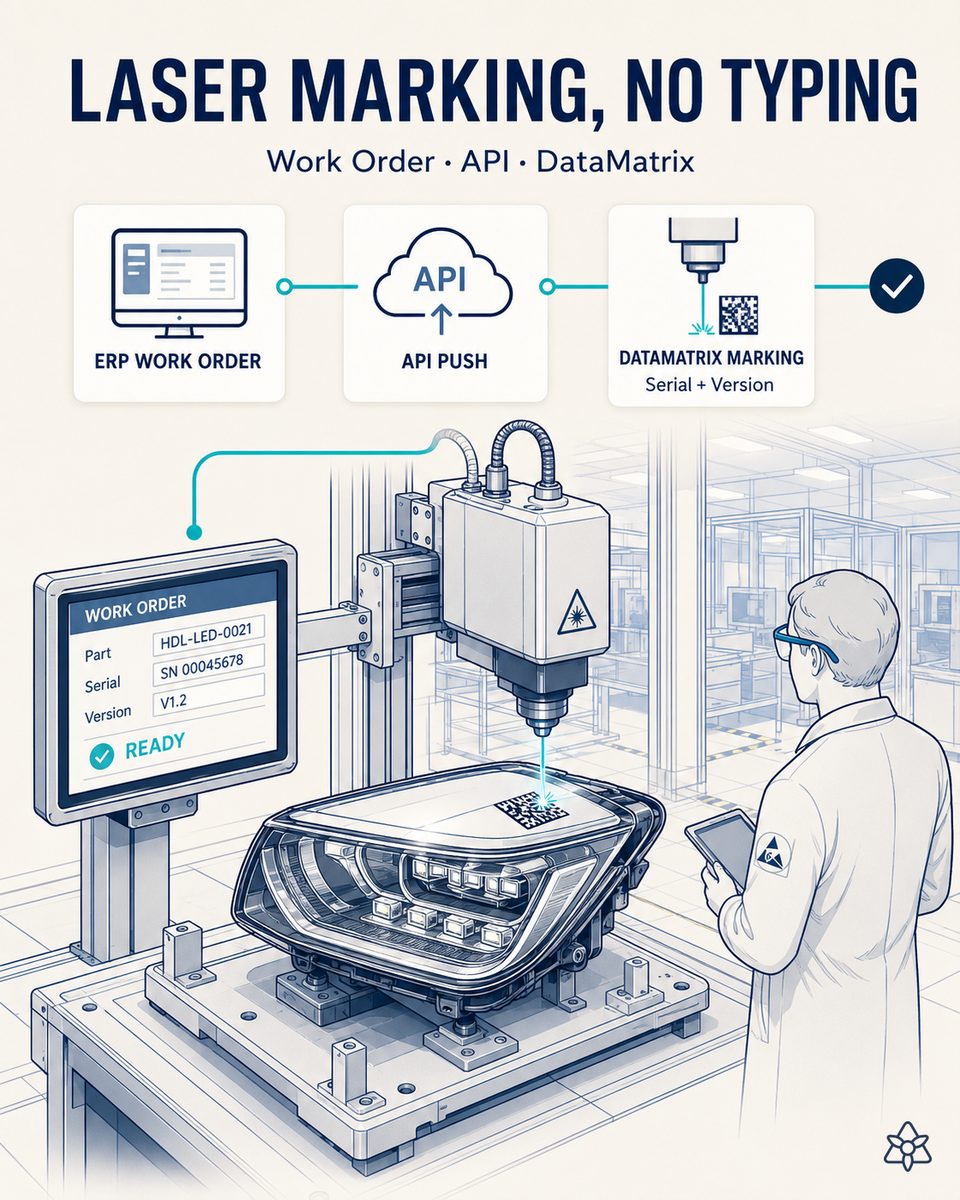
The marker has an API — but the serial is still typed by hand at every program change.
In a Tier 1 premium LED headlight plant, the laser marker that engraves the DataMatrix is the last physical step before the customer: any serial or program-version error there doesn't stay in the plant, it becomes a traceability nonconformity at the OEM. And even though the equipment is relatively modern and exposes an API, it is isolated from the ERP: the data that already lives in the production order is translated by hand on the panel.
- Manual typing at every order change — when a new production order comes in, someone types the startup serial into the marker's panel, selects the program version and fills in the destination OEM's traceability fields. One panel, several chances to make an error, no cross-check against the ERP.
- One wrong finger is half a shift compromised — a wrong serial digit, or the previous customer's program still loaded, turns half a shift's production into headlights with the wrong marking: resident-engineer escalation from the OEM in the plant and, in the worst case, a recall costing millions. Estimate to be validated with your plant's data, but that is the order of magnitude.
- Premium OEMs require bidirectional traceability — from headlight to batch and from batch to component: every individual headlight has to be reconstructable backwards. If the engraved serial doesn't correspond to the real headlight, that chain breaks right at the link the customer audits first.
The ERP knows which serial, which program version and which traceability fields apply — but it doesn't tell the marker. Someone has to translate it by hand, with the line waiting and the escalation risk on the table.
Connect stitches two modern systems together via API — a program change is one tap in the ERP, not typing at the marker.
The order change doesn't need more screens or more transcriptions: it needs the data that already lives in the ERP to reach the marker at the exact moment, without anyone rewriting it. That's what Connect is for.
When the ERP flags a production order start, it automatically publishes serial, program version and traceability fields to the laser marker. A program change between OEMs = one tap in the ERP, not typing at the marker.
How Connect operates at the marking station of a Tier 1 LED headlight plant:
- Connect stitches the two systems via API — the marker already has a modern interface; Connect connects to it and to the ERP without touching the line PLC or replacing any equipment.
- The ERP publishes at order start — startup serial, program version and traceability fields reach the marker at the very moment the production order is started, in a single transaction.
- The program travels associated to the reference — each headlight reference carries in the ERP its marking program and the DataMatrix format the destination OEM requires; changing between customers stops depending on navigating menus on the panel.
- Cross-check before releasing the line — Connect verifies that the marker has received and applied the same data the ERP published before releasing the first headlight; if anything differs, it holds and alerts.
- Individual headlight traceability — each headlight is linked to its order, its batch and its components with the serial it actually carries engraved, not the one someone typed from memory.
- Change record for the auditor — what was published, at what time, to which equipment and with what confirmation is archived, without anyone having to reconstruct it for the customer's audit.
Program change typed on the panel vs. program change published from the ERP
| Aspect | Isolated marker, manual typing | With iLEAN Connect |
|---|---|---|
| Program change at the marker | Typed and selected by hand on the panel at every order | One tap in the ERP — published automatically |
| Serial or program typing errors | 2-3 a month, some with associated resident-engineer escalation | Zero human-origin marking error |
| Individual headlight traceability | Dependent on the typing being correct | Always correct — the data comes from the active order |
| Change between premium OEMs | Navigating menus looking for the correct program | The program travels associated to the reference in the order |
| Wrong-serial recall risk | Latent at every order change | Eliminated the human-origin error that triggers it |
| Confidence in the last step | Reconstructed after the fact between systems | Auto-archived: what, when and with what confirmation. Estimate to be validated. |
Impact estimate for your plant — to validate with your numbers.
The following block is an estimate to be validated with the specific data of your plant. We lay it out so the committee has an order of magnitude; we refine it in the diagnosis.
- Tier 1 premium LED headlight plant with a relatively modern laser marker equipped with an API and several program changes per shift between OEMs.
- Connect pilot on the order change — stitches the marker to the ERP via API, without replacing equipment or touching the line PLC. First expected value in a few weeks.
- Fast payback estimated between 2 and 5 months, depending on the frequency of program changes per shift and the cost of line time at each change. Estimate to be validated.
- The hard lever is the drastic reduction in the risk of resident-engineer escalation and of mis-marking recalls: a single wrong-serial event at the customer can cost millions in containment, sorting and penalties. One recall avoided pays for the pilot many times over. Estimate to be validated.
And the quality manager's reasonable doubt
"What if the AI makes up a serial or a program version?" — it can't: in this case the AI doesn't generate data, it transports it anchored. The serial, the program version and the traceability fields come straight out of the ERP's active order; hallucination is a problem of free generation, not of anchored tasks, where the best models brought the error below 1.5% [1]. And even so, the critical decision isn't made alone: Connect reads back what the marker confirms it has applied, compares it against what was published and holds the start if anything differs, alerting the person before the first headlight goes out. The safety rings are there precisely for this.
[1] OpenAI paper "Why Language Models Hallucinate", 2025 — on the reliability of AI in anchored tasks.
What people ask about stitching the laser marker to the ERP
Why does typing at the laser marker cause recalls?
Because the marker is the last physical step before the customer, and today the serial, the program version and the traceability fields are still typed by hand on its panel at each production order change. A single fat-finger error — a wrong serial digit, or the previous OEM's program still loaded — turns half a shift's production into headlights with the wrong marking. That is no longer an in-plant defect: it becomes a traceability nonconformity at the OEM, a resident-engineer escalation and, in the worst case, a recall that costs millions in containment, sorting and penalties. The marker has an API and could receive the correct data straight from the ERP, but it is isolated — so the error keeps being introduced by hand at the one point the customer audits first.
How does iLEAN stitch the ERP to the laser marker via API?
Connect connects to the laser marker over its API — REST or OPC-UA, whatever the equipment exposes; most modern DataMatrix markers already ship one of the two. On the ERP side, Connect integrates over the Production Orders module by REST API or webhook, without touching the database directly or the line PLC. There are no intermediate files or manual exports: when the ERP flags a production order start, the serial, the program version and the traceability fields are published to the marker in a single transaction, event by event. Both systems are modern — Connect simply stitches them together so the data that already lives in the ERP reaches the marker without anyone retyping it.
What is the DataMatrix and why does bidirectional traceability matter to premium OEMs?
The DataMatrix is the 2D code the laser engraves on every headlight; it carries the serial and the fields that let each individual headlight be identified for the rest of its life. Premium OEMs require bidirectional traceability: from headlight to batch and from batch to component, so any unit can be reconstructed backwards. If the engraved serial doesn't correspond to the real headlight, that chain breaks exactly at the link the customer audits first — and the whole APQP/PPAP traceability argument falls apart. Keeping the marking aligned with what the ERP says is what keeps that chain intact per IATF 16949 and each OEM's CSR.
What happens on a program change between OEMs?
The marking program version travels associated to the headlight reference in the ERP itself: each production order carries which program, which DataMatrix format and which traceability fields the destination OEM requires. When the order starts, Connect publishes that complete package and the marker loads the correct program without anyone selecting it by hand on the panel. Changing from one OEM to another is one tap in the ERP, not navigating the marker's menus looking for the program — which is exactly where, today, a headlight slips through engraved with the previous customer's format.
Does it work if the marker is another brand?
Yes. Connect doesn't depend on the marker's make or model, only on the interface it exposes — REST API or OPC-UA — which the vast majority of modern DataMatrix markers already provide. Connect adapts to that interface on the marker side and to the ERP's API or webhook on the other; it doesn't replace the equipment or touch the line PLC. If the marker is from a different brand, the integration is the same in essence: read the serial, program version and traceability fields from the active order and publish them to the marker, then read back its confirmation before releasing the line.
Integrate your laser marker with the ERP via iLEAN — kick-off in 2 weeks. Tell us your case and we'll send you the estimated ROI for your plant in 48h.
We work on your plant's real data, not ours. Diagnosis with no commitment.
Integrate your laser marker with the ERP via iLEAN — kick-off in 2 weeks ‹ See all LED headlight cases See automotive