Edge vision on the headlight: scratches, fingerprints and LED defects caught before the customer
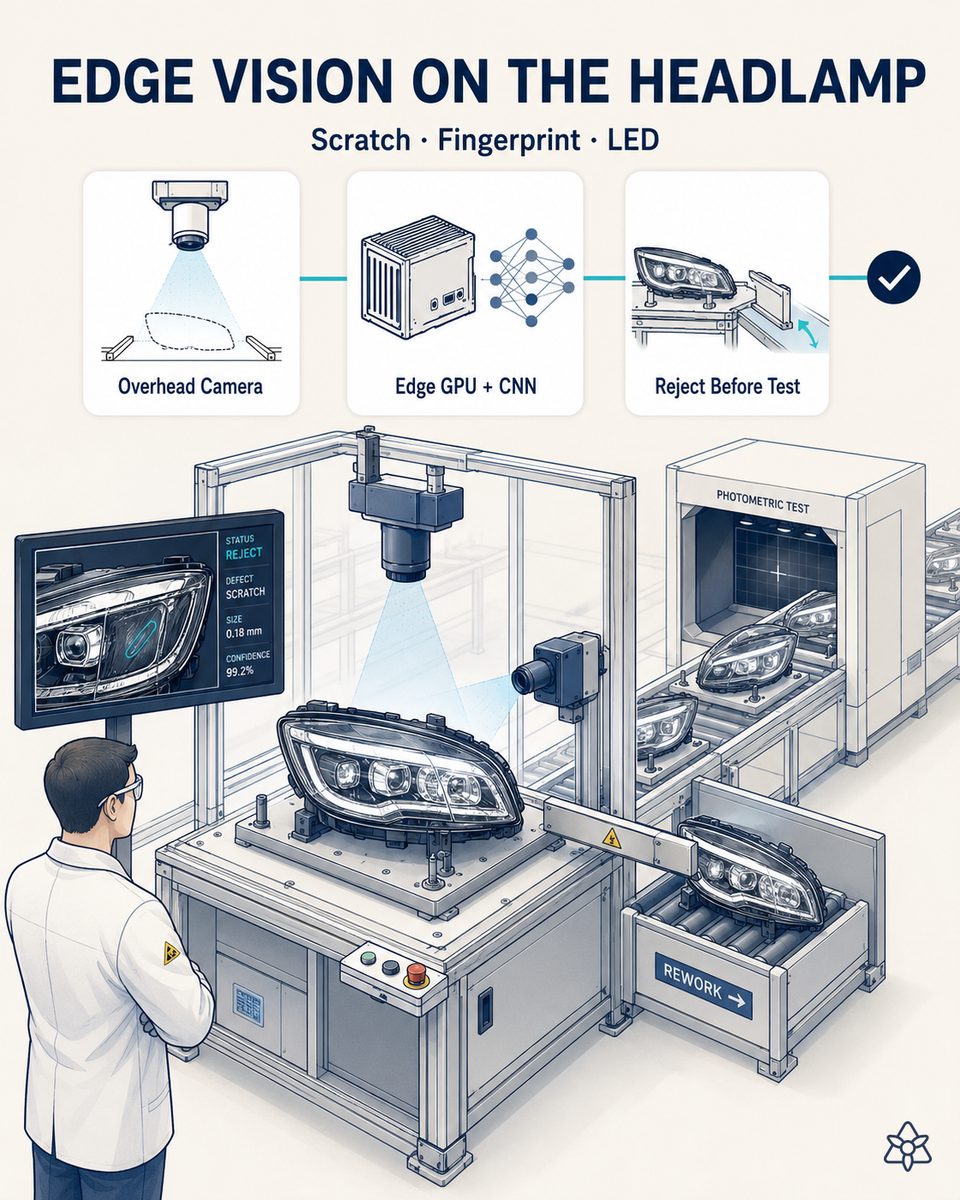
At real premium-headlight assembly cadence, the human eye misses cosmetic and opto-electrical defects: sub-millimeter scratch, fingerprint, solder-shifted LED, incorrectly torqued screw, gasket compromising IP67. Every escape to the OEM's assembly line = escalation + containment + a hit to the Q-rating. iLEAN Edge places overhead and side cameras on the cell, infers in milliseconds with a local CNN and diverts the defective headlight before the photometric test and packaging.
100% human visual control is impossible at real cadence.
In a Tier 1 premium LED headlight assembly cell, every unit comes out in tens of seconds and there are dozens of points to check: lens, housing, LED modules, screws, perimeter gasket. At that cadence, asking a person to visually verify every point of every headlight is not demanding: it is physically impossible. What exists in practice is a sample-based inspection, and sampling has two structural problems.
- It leaves gaps — quality checks a minimal fraction of the headlights produced. The sub-millimeter lens scratch, the fingerprint, the solder-shifted LED, the incorrectly torqued screw or the badly seated gasket slip through exactly on the percentage nobody looks at.
- It shows up at the customer — the defect sampling didn't catch is found by the OEM's assembler at their receiving or on their line. And an escape to the customer isn't a lost headlight: it is an escalation, a containment with 100% inspection of all stock in transit, an 8D to document and a hit to the Q-rating that conditions the next nominations.
The consequence is measured in customer ppm: on premium headlights, where the lens is the visible face of the vehicle and IP67 sealing is non-negotiable, the cost of the defect leaving the plant shoots far above the cost of internal scrap.
iLEAN Edge — overhead and side cameras, local CNN and divert before the photometric test.
The problem isn't one of criterion — the quality manager knows perfectly well what a defective headlight is — it is one of cadence and sustained attention, precisely where machine vision wins. iLEAN Edge replicates the veteran inspector's criterion at cell speed, headlight by headlight, without fatigue.
Edge sees every headlight before the photometric station. The local CNN distinguishes scratch, fingerprint, shifted LED, missing screw and badly seated gasket. The physical divert takes it out of the cell before the photometric test and packaging. It works with no cloud and without sending a single image outside the plant. Each divert is stamped with a timestamp, traceable to the headlight serial number.
The specific iLEAN piece for an LED headlight assembly cell:
- Edge — physical terminal with an overhead camera over the lens and a side camera over the housing perimeter, installed in the cell before the photometric station. It carries a CNN trained on examples from the customer's specific program and on the historical defects captured during APQP. It inspects sub-millimeter scratch, fingerprint, solder-shifted LED, missing or incorrectly seated screw and gasket that compromises IP67. Inference is local, with no image sent to the cloud — no latency, no bandwidth cost and no friction with the OEM's confidentiality requirements —: when it detects a defect, it triggers the physical divert before the photometric test and packaging.
- Connect — captures the production order, the program and the serial number in progress, whether it comes from the ERP or the MES. Each Edge divert is stamped with a timestamp and linked to the serial and the batch, so the traceability IATF 16949 requires is automatic, not a manual reconstruction.
- Agent — lives in Central, crossing the Edge history (how many headlights diverted per hour, by defect type, by shift) with the program and the production order from Connect. If the scratch always spikes after a specific tooling change, it doesn't send an email at midnight: it presents the already-crossed hypothesis to the quality manager, who validates and decides.
The Edge terminal installs over the existing assembly cell, without changing the machine. And the CNN model isn't a black box that mutates on its own: each version is documented, validated against a set of known headlights and approved by quality before entering production, with a record of which version was active in each batch.
Sample-based inspection vs. inspection with iLEAN Edge
| Aspect | Sample-based inspection | With iLEAN Edge in the cell |
|---|---|---|
| Human eye at real cadence | Impossible to check every point of every headlight | Not needed: the CNN checks every unit, tireless |
| Inspection coverage | Sampling of 1-2% of the headlights | 100% control of the headlights, at real cadence |
| Sub-millimeter scratch / fingerprint on the lens | Depends on it falling right into the sample | Local CNN on every headlight, no exception |
| Cloud vs. local inference | Cloud: latency, bandwidth cost, OEM confidentiality risk | Local Edge: no image leaves the plant, no latency |
| Escape to the customer | Escalation + containment + hit to the Q-rating | Drastic reduction (estimate to be validated) |
| Customer ppm / Q-rating | Conditioned by every escape that reaches the OEM | Lower ppm, protected Q-rating (estimate to be validated) |
Impact estimate for your plant — to validate with your numbers.
The following block is an estimate to be validated with the specific data of your plant. We lay it out so the committee has an order of magnitude; we refine it in the diagnosis.
- Tier 1 premium LED headlight plant with an assembly cell at a cadence of tens of seconds per unit and dozens of points to check per headlight.
- Edge pilot over the assembly cell — overhead and side cameras + physical divert before the photometric test, with no work on the machine. First expected value in a few weeks.
- Indicative payback between 4 and 10 months, depending on the program's current ppm ratio. Estimate to be validated against the historical ppm per program.
- Expected reduction of customer ppm and containment cost: drastic when moving from sampling 1-2% to 100% control of the headlights. (Estimate to be validated with your history.)
- The hard lever is one avoided assembler escalation: 100% containment, 8D, inspection of stock in transit and the hit to the Q-rating that conditions nominations. A single one pays for the pilot.
And the quality manager's reasonable doubt
"What if the AI gets it wrong and lets a scratch through?" — hallucination is a problem of free generation, not of anchored tasks. In tasks where the AI merely classifies an image against known patterns (this headlight matches the "good" pattern or the "defect" pattern), the best models brought the error below 1.5% [1]. And even so, it isn't decided in a vacuum: the quality manager sees the history of each shift, validates false positives in Edge's own interface and retraining enters with each model version documented and approved. The cell doesn't stop while it trains. The person sets the criterion; the machine keeps the cycle turning.
[1] OpenAI paper "Why Language Models Hallucinate", 2025 — on the reliability of AI in anchored tasks.
What people ask about LED headlight quality control with Edge
Why does the human eye miss defects at real assembly cadence?
Because at real premium-headlight cadence — tens of seconds per unit and dozens of checkpoints on each headlight (lens, housing, LED modules, screws, perimeter gasket) — a person cannot visually verify every point on every unit. What exists in practice is sample-based inspection: quality checks a minimal fraction of the headlights produced. The sub-millimeter scratch, the fingerprint, the solder-shifted LED, the incorrectly torqued screw or the badly seated gasket slip through exactly on the percentage nobody looks at. It isn't a matter of criterion — the veteran inspector knows perfectly well what a defective headlight is — it's a matter of sustained cadence and attention, precisely where machine vision wins.
What defects does the local CNN catch on the LED headlight?
The two big groups that end in an assembler complaint. On the cosmetic side: sub-millimeter scratch on the polycarbonate lens, fingerprint or grease mark on the inner or outer face, visible speck or inclusion inside the headlight. On the opto-electrical and assembly side: LED module soldered with a shift from its nominal position, missing screw or incorrectly seated screw and badly seated perimeter gasket that compromises IP67 sealing. The overhead and side cameras cover the lens and the housing perimeter, so the defective headlight is diverted before the photometric test and packaging.
Why local Edge and not cloud vision? How is the OEM's confidentiality protected?
Because Edge is a physical on-premise terminal with the CNN loaded on the device itself: inference is local and no headlight image leaves for the cloud. That solves latency, bandwidth cost and — decisive in automotive — each OEM's confidentiality requirements in one move: the geometry of a not-yet-launched program's headlight cannot circulate through third-party servers. If the plant loses WiFi or fiber, Edge keeps inspecting every headlight and triggering the divert. When the network returns, the signed log of diverts uploads to cross against the batch traceability.
How is the CNN trained on the Tier 1's own program and APQP history?
With real examples from the specific program, not a generic headlight library. During APQP, the quality manager marks good headlights and headlights with each defect type — scratch, fingerprint, shifted LED, missing screw, badly seated gasket — including the historical defects captured in the FMEAs and 8Ds of the previous program. The CNN learns the visual pattern of that lens, that housing and that LED module configuration. When a new program or an engineering change comes in, it is retrained with the new samples and the new model version is documented, validated against a set of known headlights and approved before entering production.
How does it reduce the customer ppm?
By moving from sampling 1-2% of the headlights to 100% control at real cadence: the defect that sampling didn't catch — and that today the OEM's assembly line finds on receipt or on its line — is diverted inside the cell, before the photometric test and packaging. Fewer escapes to the customer means a lower customer ppm and, above all, fewer escalations: every avoided escape removes a containment with 100% inspection of stock in transit, an 8D to document and a hit to the Q-rating that conditions future nominations. Estimate to be validated against the program's historical ppm.
Keep the defect from leaving your cell — we'll send you in 48h the estimated ROI of this AI project for your LED headlight line.
We work on your plant's real data, not ours. Diagnosis with no commitment.
Edge pilot on your assembly cell — 8-12 weeks ‹ See all LED headlight cases See automotive