OEM program setup validated by Edge vision before startup
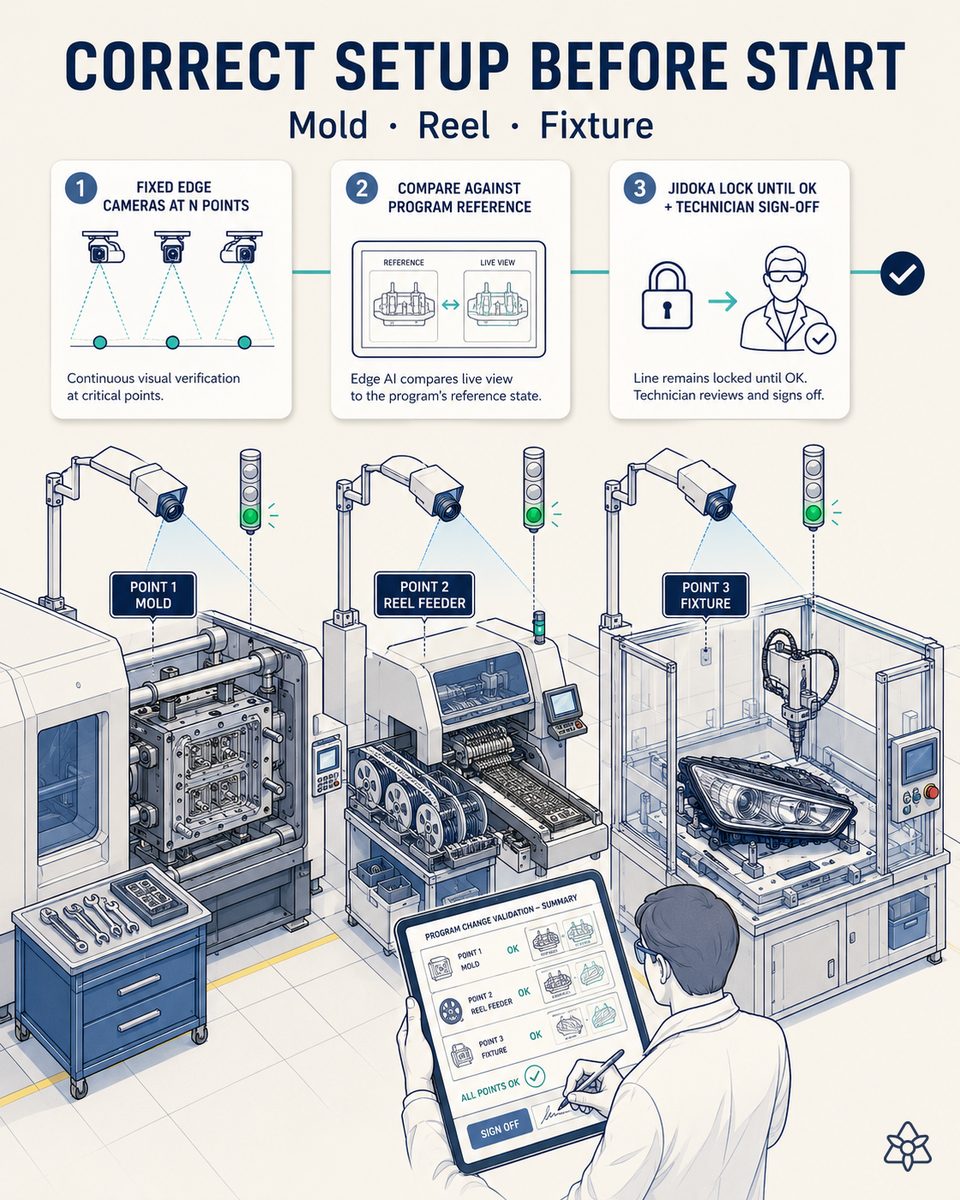
A premium headlight plant chains 4-6 different OEM programs per shift. Every changeover involves the injection mold, LED reel, fixture, laser-marking program and sealer parameters — and a single mis-changed element means a contaminated first batch and escalation with the customer. With iLEAN Edge, fixed cameras compare the current state of each critical point against the reference state of the incoming program, and AI Jidoka locks startup until they all give OK and the quality technician signs. Three safety rings active on every program changeover.
The changeover between OEM programs is what makes or breaks the line's OEE.
With the program in steady state, a premium headlight line is stable. The risk concentrates in the program changeover: the moment the same press, the same feeder and the same assembly station switch from one OEM to another and everything depends on the five setup elements —injection mold, LED reel, fixture, laser-marking program and sealer parameters— having changed correctly, first time, 4 to 6 times per shift.
- If the program starts wrong, the first batch is lost — a mold from the previous variant, a reel with the wrong binning or the wrong program's fixture contaminates the first batch before anyone detects it, and that batch is historically the most problematic of every program.
- The setup sign-off is already a PPAP requirement — but today it is not anchored in structured visual evidence: the quality technician signs a checklist walked in a hurry between two programs, with no objective record of the real state of each point.
- Escalation with the OEM is decided here — a contaminated first batch that reaches the customer is not an internal deviation: it is an 8D claim, a process audit and pressure on the ppm the OEM buyer looks at first.
A poorly verified program changeover comes down to the same thing: first batch lost, ppm penalized and escalation with the customer. A supply relationship built over years can be compromised in a single badly started setup.
Edge gives the OK point by point — AI Jidoka won't let the program start until every one has said yes.
The changeover between OEMs isn't solved with a longer checklist for the quality technician: it's solved by giving them objective visual evidence of each critical point of the setup before they sign the release, and by making the line physically unable to start while that evidence is incomplete. That combination is Edge plus AI Jidoka.
Edge verifies each critical point of the changeover — mold in the press, LED reel in the feeder, fixture in its slot, laser marking, sealer. AI Jidoka doesn't release startup until every camera gives OK. The quality technician signs on the visual evidence and the validated first piece, not on a blind checklist.
The iLEAN pieces applied to the program changeover:
- Edge — industrial cameras with CNNs trained to recognize "correct mold in position," "LED reel with the correct binning loaded" and "correct program fixture in its slot," fixed at the critical points of the setup: injection press, feeder, assembly station, laser-marking station and sealer. Each camera learns the reference state of that point for every OEM program and compares against it on every changeover.
- AI Jidoka — receives each camera's verdict and acts as the startup gate: while a single critical point is not OK, the line stays held. It is not an alert someone can ignore under schedule pressure; it is an active startup lock until the evidence is complete.
- Quality technician's electronic signature on evidence — when every camera gives OK, the technician receives the summary with the photos of each critical point and signs the program release. The signature stays human and mandatory — what changes is that it is no longer signed on a checklist walked in a hurry, it is signed on structured visual evidence point by point.
- Three safety rings in parallel — Edge visual verification of the setup, first-piece validation of the incoming program and the quality technician's electronic signature. No ring replaces another; the three stay archived per program changeover, ready for the PPAP file or the OEM audit without reconstructing anything weeks later.
Blind sign-off vs. sign-off on visual evidence per critical point of the setup
| Aspect | Classic program changeover | With iLEAN Edge + AI Jidoka |
|---|---|---|
| Evidence quality signs on | Blind sign-off with contamination risk on the first batch | Sign-off backed by archived photographic visual evidence, point by point |
| Mold, reel and fixture verification | By eye, per checklist, with no objective record | CNN at each critical point compares against the incoming program's reference state |
| LED reel binning | Trust that the loaded reel is the one declared in the order | Reel label read and checked against the bin the program requires |
| First-batch ppm | The most problematic batch of each program, exposed at every start | Protected: the program doesn't start until every point is OK |
| Changeover speed and OEE | Manual re-verifications stretch startup and penalize OEE | Combined with AI SMED, faster changeover without penalizing OEE |
| Evidence archive for the OEM or PPAP audit | Reconstructed by hand after the claim | Dossier per changeover: photo + Edge verdict + first piece + signature, archived |
Impact estimate for your plant — to validate with your numbers.
The following block is an estimate to be validated with the specific data of your plant. We lay it out so the committee has an order of magnitude; we refine it in the diagnosis.
- Premium headlight line chaining 4-6 different OEM programs per shift, each changeover with its five setup elements: mold, LED reel, fixture, laser-marking program and sealer parameters.
- Edge + AI Jidoka pilot over the five critical points of the changeover (cameras + startup gate + integration with the quality technician's signature and first-piece validation). First expected value in 4 weeks.
- What it protects is the first-batch ppm of every program — historically the most problematic of the shift. Every first batch that starts clean removes risk from the metric the OEM buyer looks at first. Estimate to be validated.
- The payback is a function of the number of program changeovers per shift: the more OEMs share the same line, the sooner the pilot pays back. Estimate to be validated with your data.
- Combined with AI SMED, the effect is twofold: the program changeover accelerates without penalizing OEE, because the visual validation removes the manual re-verifications that stretch startup today. Estimate to be validated.
And the quality technician's reasonable doubt
"What if the camera gives OK to a mold that isn't actually the program's, or the other way round, locks the line for no real reason?" — hallucination is a problem of free generation, not of anchored tasks. In tasks where the AI merely compares the current image of a critical point against its previously validated reference state —which is exactly what Edge does here— the best models brought the error below 1.5% [1]. And even so, the critical decision isn't made alone: AI Jidoka holds startup, the first piece confirms and the quality technician signs, seeing the evidence that backs each point. The three iLEAN safety rings are there precisely for this — the AI proposes, the quality technician decides.
[1] OpenAI paper "Why Language Models Hallucinate", 2025 — on the reliability of AI in anchored tasks.
What people ask about the program changeover with Edge and AI Jidoka
Why does the changeover between OEM programs concentrate the ppm risk?
Because with the program in steady state the line is stable — the risk lives in the changeover. That's the moment when the same press, the same feeder and the same assembly station switch from one OEM to another and everything depends on the five setup elements —injection mold, LED reel, fixture, laser-marking program and sealer parameters— having changed correctly, first time, 4 to 6 times per shift. If the program starts wrong, the first batch is lost: a mold from the previous variant, a reel with the wrong binning or the wrong program's fixture contaminates the first batch before anyone spots it, and that batch is historically the most problematic of every program. That is why the ppm the OEM buyer looks at first is decided here, not in steady-state running.
How does the camera validate that the mold, the reel and the fixture are the correct ones?
With fixed industrial cameras running CNNs trained to recognize "correct mold in position," "LED reel with the correct binning loaded" and "correct program fixture in its slot," one per element that changes with the program: mold in the injection press, reel in the feeder, fixture in its slot at the assembly station, laser-marking station and sealer. Each camera learns the reference state of that point for every OEM program in the catalog and compares against it on every changeover, not once per shift. For the reel it reads the datamatrix label —reference, luminous-flux bin and color-temperature bin— and checks it against the binning the incoming program requires. If a point doesn't match, it is flagged non-conforming and AI Jidoka holds the line.
What does AI Jidoka do when it locks startup?
AI Jidoka is the orchestration layer that turns the Edge cameras' verdict and the quality technician's signature into an active startup lock on the line. It takes its name from the classic jidoka principle —stop at the anomaly instead of letting it move forward— but applied by AI to the changeover between OEMs: while a single critical point is not OK, the line stays held. It's not an alert someone can ignore under schedule pressure; the gate opens only when the structured visual evidence of the setup is complete and signed. If a camera loses a valid reading, AI Jidoka is designed to fail closed, not open — the absence of data is never a green light, it means more verification, not less.
How does AI SMED speed up the changeover without penalizing OEE?
Combined with AI SMED, the effect is twofold: the changeover accelerates without penalizing OEE, because the visual validation removes the manual re-verifications that stretch startup today. When each critical point of the setup is confirmed against its reference state by the camera, the quality technician no longer walks a checklist twice between two programs; the sign-off rests on structured visual evidence captured at the moment of the change. Less time held for re-checks, the same or better first-batch ppm — the two levers pull together rather than against each other. Estimate to be validated with your data.
Does Edge replace the quality technician's sign-off, or back it?
It backs it, always. Edge does not replace the human signature or the first-piece validation: it reinforces them. iLEAN keeps three safety rings active in parallel —Edge visual verification of each critical point of the setup, first-piece validation of the incoming program and the quality technician's electronic signature on that evidence—. What Edge adds is that the signature, already a PPAP requirement, no longer rests on a checklist walked in a hurry between two programs: the technician signs on structured visual evidence point by point, captured at the moment of the changeover and archived. No ring depends on another to exist.
AI Jidoka pilot on your next program changeover — 4 weeks.
We work on your plant's real data, not ours. Diagnosis with no commitment.
AI Jidoka pilot on your next program changeover — 4 weeks ‹ See all LED headlight cases See automotive