The assembly supervisor dictates while walking, and iLEAN listens
The final assembly supervisor for premium headlights walks 7 hours a day between cells, hands full. Everything in their head dies at the end of the shift. With iLEAN Connect earpiece mode they dictate while walking; iLEAN structures the note as a nonconformity candidate linked to the active program and cell, and returns support within seconds.
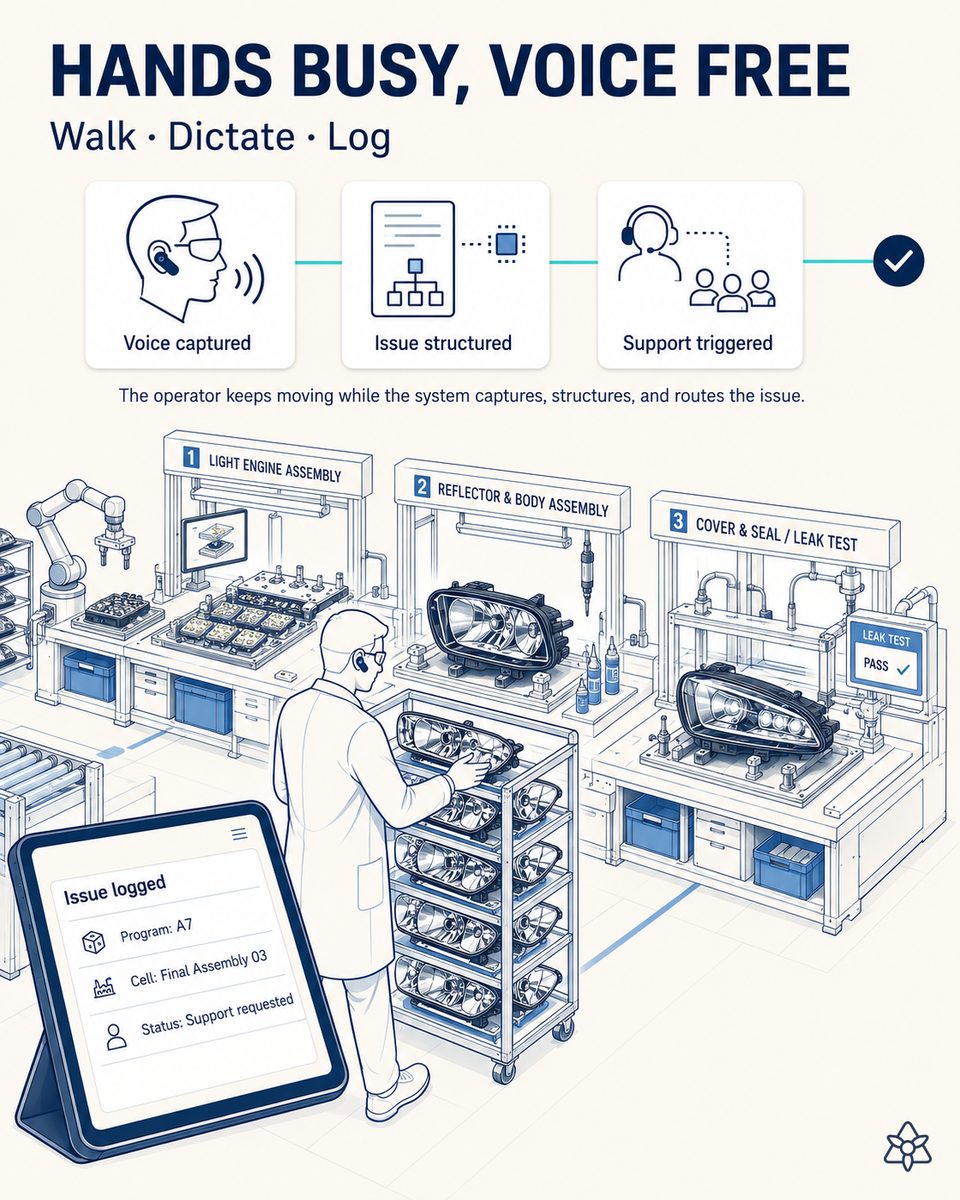
Nobody asks the assembly supervisor anything — because they can't type.
In a Tier 1 premium LED headlight plant, the final assembly supervisor is not sitting in front of a screen: they are walking between assembly cells, hands full, seven hours a day. They are the first person to see the patterns no sensor reports:
- A drift in a process parameter — a cell that starts behaving differently long before the data trips any formal alarm.
- A correlation between an LED reel and rework — «since that reel came in, this cell reworks more» — that nobody logs in the moment today because there is nowhere to type between cells.
- The founded feeling that cell X is running worse this week — real operational knowledge that gets reconstructed days later, from memory, if it gets reconstructed at all.
All of that dies at the end of the shift. It never enters the system, never gets cross-checked against the line data and, above all, never feeds the program's live FMEA or the continuous-improvement plan: the occurrence and detection ratings get reviewed with whatever someone manages to remember in the weekly meeting, not with what the supervisor saw on the floor while it was happening.
Connect in hands-free voice mode — the supervisor takes notes by dictating, without putting anything down.
The earpiece is not a system that records the supervisor during the shift: it is a tool they activate voluntarily when they want to note something down. They decide when they speak and what they dictate. Connect structures it, links it to the active plant context and returns it in seconds.
The supervisor says «iLEAN, note this». They dictate the observation in their own words, walking between cells. Connect structures it as a nonconformity candidate linked to the active program, cell, shift and operator. Seconds later, the response arrives by voice to the earpiece or as a push to the lead's tablet.
How Connect operates in earpiece mode in a premium LED headlight plant:
- Custom wake-word — the supervisor opens the note with a phrase of their own that only they say deliberately. Outside that phrase, the earpiece transcribes and sends nothing.
- Free dictation, no forms — they speak in their own words, just as they would tell a colleague: «cell 4 is giving more lens-bonding rework since the reel change».
- The LLM structures the note — Connect turns the dictation into a nonconformity candidate with clear fields, automatically linked to the program, cell, shift and operator active at that moment, without the supervisor having to recite any of it.
- Response by voice or push — the confirmation arrives at the same earpiece or, if more context is needed, as a push notification to the cell lead's tablet. The supervisor keeps walking, with the observation already in the system.
- Human verification before signing — nothing signs off as a formal nonconformity without passing through human verification on the tablet: a person reviews the draft, completes it and escalates it per the plant's quality-system procedure.
Knowledge that dies at shift end vs. knowledge that enters the system in real time
| Aspect | Without earpiece | With iLEAN Connect in earpiece mode |
|---|---|---|
| Operational knowledge from the shift | Dies at shift end, in the supervisor's head | Enters the system in real time and feeds the live FMEA |
| Taking a note between cells | No keyboard, hands full — nothing gets logged | Dictated by voice, hands free, without stopping walking |
| Pattern spotted on the line (drift, reel ↔ rework) | Reconstructed days later from memory, if at all | Captured the first time the supervisor sees it, structured |
| Link to program, cell, shift and operator | Depends on someone remembering and reconstructing it | Automatic — the system already knows what is active |
| Logging as a nonconformity | Written up hours later from memory, or not at all | Enters as a nonconformity candidate, pending human verification |
| Response to the supervisor | Nobody replies — the observation just disappears | By voice to the earpiece or push to the lead's tablet, in seconds |
Strategic value for your program — to be validated with continuous improvement.
This case has a different character from other Connect projects: its value is strategic, not directly monetizable. It doesn't replace a manual task with a calculable minutes saving; it is the enabling piece of the program's entire continuous-improvement system: it stops the assembly supervisor's operational knowledge from being lost. We frame it this way so the committee evaluates it with the right yardstick.
- Tier 1 premium LED headlight plant with a final assembly supervisor who walks most of the shift between cells, hands full and with no practical keyboard access.
- Connect pilot in earpiece mode on a single cell or shift — without changing the supervisor's role, without adding administrative tasks.
- The main return is not an accountable hours saving: it is feeding the live FMEA and the continuous-improvement plan with real data instead of memory reconstructions in the weekly meeting.
- There is an expected operational return too: the reduction of rework through early drift detection — the pattern the supervisor sees days before the rework piles up. That reduction is an estimate to be validated with the plant's continuous-improvement lead, not a generic figure invented here.
And the plant manager's fair concern
«Doesn't this end up being a system that records everything my supervisor says?» — no. It is exactly the opposite: the earpiece hears nothing until the supervisor activates it with their wake-word. There is no background recording, no continuous transcription, nobody listening to their conversation with a cell operator. The only thing that enters the system is what they themselves decide to dictate — because they want it on record, not because someone above asked for it. And the second concern, «what if the AI makes up half a nonconformity?»: for anchored tasks like this one — structuring a dictation against the active program, cell and shift — the AI has a reliability far from the hallucination problem of free-form generation [1], and even so nothing signs off as a formal nonconformity without passing through human verification on the tablet.
[1] OpenAI paper "Why Language Models Hallucinate", 2025 — on the reliability of AI in anchored tasks.
What people ask about the supervisor's earpiece in an LED headlight plant
Why does the assembly supervisor's knowledge die today?
Because the person who sees the most is the one who can least write it down. The final assembly supervisor for premium headlights walks most of the shift between cells with their hands full — there is no keyboard between cells. The patterns they spot (a drift in a process parameter, a correlation between an LED reel and rework, the founded feeling that cell X is running worse this week) stay in their head until the end of the shift, if they make it that far. Nobody asks them anything because there is no practical way for them to type it, so that operational knowledge never enters the system and never feeds the live FMEA or the improvement plan.
Does the supervisor have to type anything, or how does the voice dictation work?
They never have to type. The supervisor opens the note with a custom wake-word that only they say deliberately, then dictates the observation in their own words while walking — «cell 4 is giving more lens-bonding rework since the reel change». Outside that phrase the earpiece transcribes and sends nothing: there is no background recording and no continuous listening. It is a tool the supervisor chooses to use to take a note — they decide when to speak and what to dictate — not a system that records what they do or say during the shift.
How is the note linked to the program, cell and shift?
Automatically, in the moment it happens. When the supervisor dictates, Connect structures the note as a nonconformity candidate linked to the active program, cell, shift and operator — the system already knows what is running at that point, so the supervisor never has to recite those fields. The reply comes back by voice to the earpiece or, if more context is needed, as a push to the cell lead's tablet, while the supervisor keeps walking with the observation already in the system.
How does this feed the live FMEA and the improvement plan?
Every observation enters structured and linked to the program and cell the moment it occurs: the drift in a process parameter, the correlation between an LED reel and rework, the founded feeling that a cell is running worse this week. The quality team reviews those candidate nonconformities and updates the occurrence and detection ratings of the program's live FMEA with them — with data captured on the floor, not with what someone manages to reconstruct from memory in the weekly meeting. That is the enabling piece of the continuous-improvement plan.
Does it work in the noise of an assembly hall?
It is built exactly for that environment. The proximity microphone is worn close to the mouth and the voice model is trained on real plant conditions: metallizers running, adhesive-application robots, transfer belts, photometry benches in the background. When transcription confidence drops below a threshold, Connect does not invent the missing word: it asks for a short voice confirmation («did you say cell 4 or cell 14?») before structuring anything. Better one question too many than a nonconformity linked to the wrong cell.
Try the iLEAN earpiece on a pilot cell — 2 weeks. Tell us your case and within 48h we'll send you the estimated ROI of this AI project for your premium LED headlight plant.
We work on your plant's real data, not ours. No-commitment diagnosis.
Try the iLEAN earpiece on a pilot cell — 2 weeks ‹ See all LED headlight cases See automotive